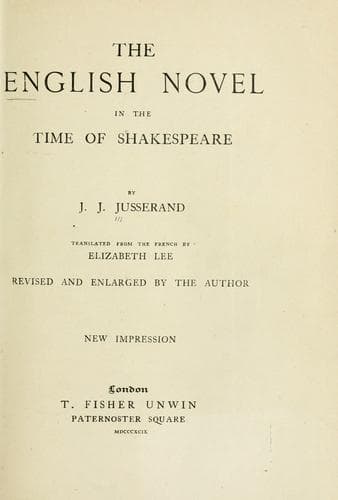
The English Novel in the Time of ShakespeareJusserand, J. J. (Jean Jules)
History
The English Novel in the Time of Shakespeare
Jusserand, J. J. (Jean Jules)
English fiction -- Early modern, 1500-1700 -- History and criticism
his knes, and mumbling twenty _Ave Maryes_ to hymselfe, in the
sacrifizing of it on the coales, that his diligent service in the
broyling and combustion of it, both to his kingship and to his
fatherhood might not seeme unmeritorious."[287]
However careful Thomas Nash had been to act according to the views
attributed to Dr. Andrew Borde concerning the cultivation of mirth as a
preservative of health, he reached what this authority calls "the mirth
of heaven," with much more rapidity than might have been expected. His
mirth diet was obviously adulterated and mingled with wrath and sorrow.
He had been born in 1567, and we read about him in a comedy performed
at Cambridge in 1601, these verses which are friendly if not very
poetical:
[Illustration: "TOM NASH HIS GHOST."]
"Let all his faultes sleepe with his mournfull chest,
And there for ever with his ashes rest,
His style was wittie, though it had some gall,
Some things he might have mended, so may all,
Yet this I say, that for a mother witt,
Few men have ever seen the like of it."[288]
The manner in which his friend Dekker represents him, shortly after,
reaching the Elysian fields, leaves little doubt that his life was
shortened not only by his angry passions, but by sheer want: "Marlow,
Greene and Peele had got under the shades of a large vyne, laughing to
see Nash, that was but newly come to their colledge, still haunted with
the sharpe and satyricall spirit that followed him heere upon earthe:
for Nash inveyed bitterly, as he had wont to do against dryfisted
patrons, accusing them of his untimely death, because if they had given
his Muse that cherishment which she most worthily deserved, hee had fed
to his dying day on fat capons, burnt sack and sugar, and not so
desperately have venturde his life and shortned his dayes by keeping
company with pickle herrings."[289]
III.
Some of Shakespeare's contemporaries attempted to give their readers
"the like" of Nash's wit, and tried their hand either at the picaresque
novel or at the reproduction of scenes taken from ordinary life, of
which Greene also had left some examples. The comic school was far from
equalling the fecundity of its romantic rival; it existed however, and
though absolutely forgotten now, it helped to keep up and improve the
natural gift of observation which belonged to the English race.
Public-domain text, read in full here on John Shaqi.
Reviews
Reviews
No reviews yet
Be the first to share your thoughts on this work.
Elsewhere in the archive
Join the Discussion
Join the discussion
Sign in to leave a comment or review.
Sign InorCreate an account