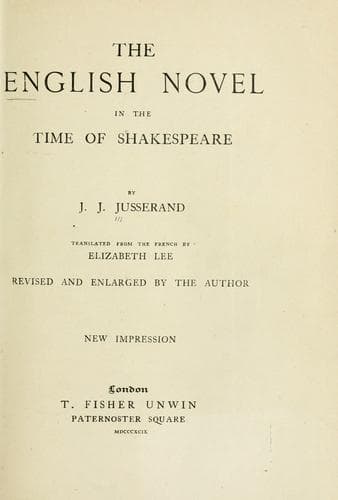
The English Novel in the Time of ShakespeareJusserand, J. J. (Jean Jules)
History
The English Novel in the Time of Shakespeare
Jusserand, J. J. (Jean Jules)
English fiction -- Early modern, 1500-1700 -- History and criticism
Such topics, and many more of a higher order, which were the subject of
persistent debate in the drawing-rooms of the Hotel de Rambouillet, were
also discussed in England; there was, it is true, no Hotel de
Rambouillet, but there was the house of the Philips at Cardigan. There
was no Marquise, but there was Catherine Philips, the "matchless
Orinda," who did much to acclimatize in England the refinements,
elegancies, and heroism _a panache_ of her French neighbours. With
the help of her friends she translated some of the plays of Corneille,
not without adding something to the original to make it look more
heroical. The little society gathered round her imitated the feigned
names bestowed upon the habitues of the Parisian hotel. While she went
by the name of Orinda, plain Mr. Philips, her husband, was re-baptized
Antenor; her friend Sir Charles Cotterel, translator of "Cassandre," was
Poliarchus; a lady friend, Miss Owen, was Lucasia;[332] fine names, to
be sure, which unfortunately will remind many a reader not only of
matchless Arthenice, of the Hotel de Rambouillet, but of Moliere's
Cathos and Madelon, who, too, had chosen to imitate the Marquise, and
insisted on being called Aminte and Polixene, to the astonishment of
their honest father.[333]
The high morality and delicacy, both of the "Hotel," and, alas, of
Moliere's "Precieuses," were also imitated at Cardigan. To get married
was a thing so coarse and vulgar that people with refined souls were to
slip into that only at the last extremity. "A fine thing it would be,"
says the Madelon of the "Precieuses," "if from the first Cyrus were to
marry Mandane and if Aronce were all at once wedded to Clelia!" We have
seen that such is not the case, and that ten volumes of adventures
interpose between their love and their marriage. In the same way an
eternal friendship, a marriage of soul to soul, having been sworn
between Orinda and Lucasia, it was a matter of great sorrow, shame and
despair for the first when the second, after thirteen years of this
refined intercourse proved frail and commonplace enough to marry a lover
of appropriate age, fortune and position.
Another centre for heroic thoughts and refined morality was the country
house of the pedantic but pretty Duchess of Newcastle, a prolific writer
of essays, letters, plays, poems, tales, and works of all kinds. To her,
literature was a compensation for the impossibility, through want of
opportunity, of performing with her own hand heroical deeds: "I dare not
examine," says she, "the former times, for fear I should meet with such
of my sex that have out-done all the glory I can aime at or hope to
attaine; for I confess my ambition is restless, and not ordinary;
because it would have an extraordinary fame. And since all heroick
actions, publick employments, powerfull governments and eloquent
pleadings are denyed our sex in this age or at least would be condemned
for want of custome, is the cause I write so much."[334]
Public-domain text, read in full here on John Shaqi.
Reviews
Reviews
No reviews yet
Be the first to share your thoughts on this work.
Elsewhere in the archive
Join the Discussion
Join the discussion
Sign in to leave a comment or review.
Sign InorCreate an account