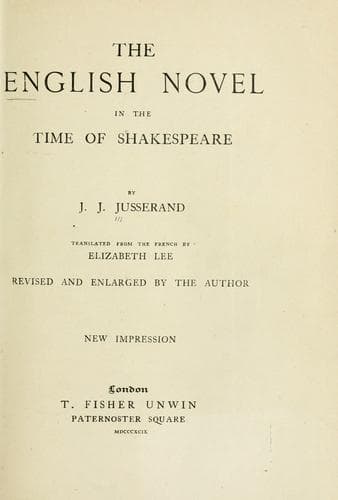
The English Novel in the Time of ShakespeareJusserand, J. J. (Jean Jules)
History
The English Novel in the Time of Shakespeare
Jusserand, J. J. (Jean Jules)
English fiction -- Early modern, 1500-1700 -- History and criticism
But reading and translating was not enough for a society so enamoured of
heroical romances; some original ones were to be composed for English
readers and the composing of them became a fashionable pastime. "My lord
Broghill," writes again Dorothy Osborne to her future husband, Sir
William Temple, the patron hereafter of the yet unborn Jonathan Swift,
"sure will give us something worth the reading. My Lord Saye, I am told,
has writ a romance since his retirement in the isle of Lundy, and Mr.
Waller they say is making one of our wars, which if he does not mingle
with a great deal of pleasing fiction, cannot be very diverting, sure,
the subject is so sad."[340]
The following year, that is 1654, the English public received, according
to Dorothy's previsions, the first instalment of the most noticeable
heroical romance composed in their language. It was called
"Parthenissa,"[341] and had for its author Roger Boyle, Lord Broghill,
afterwards Earl of Orrery, one of the matchless Orinda's great
friends.[342]
In this heroic romance, the imitation of France is as exact as possible;
the few literary qualities perceptible in the vast compositions of
Mdlle. de Scudery and of La Calprenede, do not shine with any brighter
lustre in "Parthenissa." As in France ancient history is put to the
torture, though Scudery, as we have seen, had set up as a rule that the
truth of history was to be respected in romances; of observation of
nature there is little or none, and the conversations of the characters
are interminable. "Turning over the leaves of the large folio," wrote
one of the last critics who busied themselves with this work, "I
perceived that ... the story some-how or other brought in Hannibal,
Massinissa, Mithridates, Spartacus, and other persons equally well
known.... How they came into the story or what the story is I cannot
tell you; nor will any mortal know any more than I do, between this and
doomsday; but there they all are, lively though invisible, like carp in
a pond."[343] We must make bold, though doomsday has not yet come, to
draw forth some of these carp out of the water, and, after all, this is
not the darkest pond in which we shall have fished.
Public-domain text, read in full here on John Shaqi.
Reviews
Reviews
No reviews yet
Be the first to share your thoughts on this work.
Elsewhere in the archive
Join the Discussion
Join the discussion
Sign in to leave a comment or review.
Sign InorCreate an account