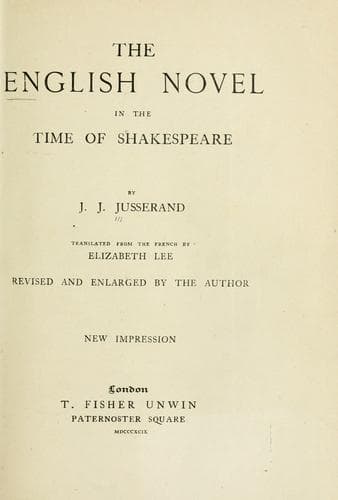
The English Novel in the Time of ShakespeareJusserand, J. J. (Jean Jules)
History
The English Novel in the Time of Shakespeare
Jusserand, J. J. (Jean Jules)
English fiction -- Early modern, 1500-1700 -- History and criticism
Boyle, it is said, besides his dramas and other works, again tried his
fortune as a novel writer, and published in 1676 "English Adventures by
a person of honour." It is in a style so absolutely different from his
former romance that it is scarcely credible that both came from the same
pen. "English Adventures" tell the story of the amours of King Henry
VIII., of Brandon, and others. All the reserve in "Parthenissa" has
entirely disappeared, and scenes are presented to the eye which, except
at the time of the Restoration, have usually been veiled. Love is in
this novel the subject of many discussions, and so it was in heroic
romances, but while it was spoken of there with decency and dignity, it
is never mentioned in "English Adventures" but in a tone of banter and
raillery. The discourses about this passion recall Suckling's ideas much
more than those of Madeleine de Scudery. "Pardon me, madam, Wilmore
reply'd, if I think you mistake the case, for I never said I was for a
siege in Love: that is the dull method of those countries whose
discipline in amours I abominate. I am for the French mode, where the
first day, I either conquer my mistress or my passion." Whether or not
this be according to "the French mode," we are obviously very far from
the Montausier ideal. The author continues: "Nor indeed did I ever see
any woman (I mean in France) cry up constancy, but she was decaying; for
when any thing but love is to maintain love 'tis a proof Beauty cannot
do it, and then, alas, nothing else can."[345] If this and the very
licentious adventures which follow are really Boyle's, it must be
conceded that the change worked upon him by the new Restoration manners
was indeed vast and comprehensive.
Other original attempts at the heroical romance were made in England at
this period. It will be enough to mention one more. The two main defects
of the heroical dramas of Dryden and his contemporaries are bombast in
the ideas and bad taste in the expressions. In Crowne's heroical novel
of "Pandion and Amphigenia"[346] both defects are pushed to an extreme
which, incredible as it may seem to the readers of Dryden, was never at
any time reached by the laureate.
Public-domain text, read in full here on John Shaqi.
Reviews
Reviews
No reviews yet
Be the first to share your thoughts on this work.
Elsewhere in the archive
Join the Discussion
Join the discussion
Sign in to leave a comment or review.
Sign InorCreate an account