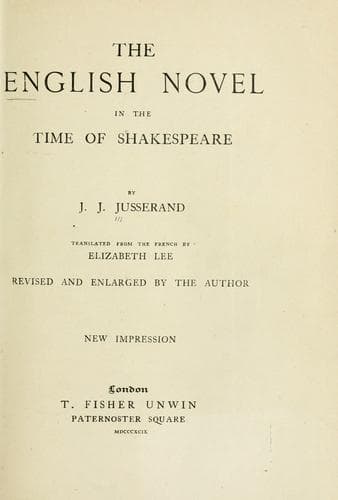
The English Novel in the Time of ShakespeareJusserand, J. J. (Jean Jules)
History
The English Novel in the Time of Shakespeare
Jusserand, J. J. (Jean Jules)
English fiction -- Early modern, 1500-1700 -- History and criticism
Persistent and close analysis of human emotion and of the passion of
love in the way in which Sir Philip Sidney had caught sight of it,
disappeared from the novel until the day when a second "Pamela" was to
figure on the literary stage, and to fill with emotion all London and
Paris, down even to Crebillon fils, who was to write to Lord
Chesterfield: "Without 'Pamela' we should not know what to read or to
say." And at reading it, the author of "The Sopha" was "moved to tears."
One work alone was published towards the end of the century in which an
original thought is to be found, the "Oroonoko"[369] of Mrs. Behn. The
sentiment that animates it is of another epoch, and belongs to a quite
peculiar class of novel; with her begins the philosophical novel,
crowded with dissertations on the world and humanity, on the vanity of
religions, the innocence of negroes, and the purity of savages. These
are the ideas of Rousseau before Rousseau: other ideas of Rousseau had
been, as we have seen, anticipated, in the history of the novel, by
Lyly.
Remains of the ordinary heroic style are of course not wanting. Being
love-struck Oroonoko, an African negro, well read in the classics,
refuses to fight, and following Achilles' example, retires to his tent.
"For the world, said he, it was a trifle not worth his care. Go,
continued he, sighing, and divide it amongst you, and reap with joy what
you so vainly prize!" In trying to carry out this advice his companions
are utterly routed, until after two days Oroonoko consents to take up
his arms again, and the victors are at once all put to flight.
Oroonoko's death is also in the heroical style, but a peculiar sort of
heroism which recalls Scudery, and at the same time Fenimore Cooper.
Public-domain text, read in full here on John Shaqi.
Reviews
Reviews
No reviews yet
Be the first to share your thoughts on this work.
Elsewhere in the archive
Join the Discussion
Join the discussion
Sign in to leave a comment or review.
Sign InorCreate an account