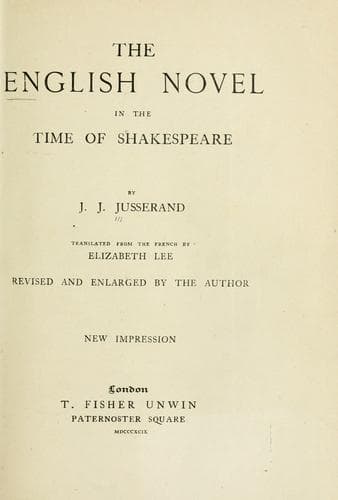
The English Novel in the Time of ShakespeareJusserand, J. J. (Jean Jules)
History
The English Novel in the Time of Shakespeare
Jusserand, J. J. (Jean Jules)
English fiction -- Early modern, 1500-1700 -- History and criticism
It can, all things considered, be stated with truth that, between the
age of Elizabeth, and the age of Anne and the Georges, there is in the
history of the novel a long period of semi-stagnation. The seventeenth
century, which furnishes hardly any important name, added very little,
apart from an exaggerated heroism, to the art of the novel. Defoe,
Richardson and Fielding are, as novelists, more nearly related to the
men of the time of Shakespeare than to the men of the time of Dryden.
They have been thus so completely separated from their literary
ancestors that the connection has been usually forgotten. It cannot,
however, be doubted.
Now that we have carried so far this sketch of the history of the early
English novel, as far indeed as the time of writers whose works are
still our daily reading, we have to take leave of our heroes, picaroons,
and monsters, of Arthur and Lancelot, Euphues and Menaphon, Pyrocles and
Rosalind, Jack Wilton and Peregrine, Oroontades and Parthenissa; nor let
us forget to include in this farewell our Lamias, Mantichoras, dragons,
and all the menagerie of Topsell and of Lyly. Mummified, buried and
forgotten as most of these romances have long been, they managed somehow
not to die childless, but left behind them the seed of better things.
"No, those days are gone away," says Keats, thinking of the legends of
early times,
"And their hours are old and grey,
And their minutes buried all
Under the down trodden pall
Of the leaves of many years....
Gone, the merry morris din;
Gone, the song of Gamelyn;
Gone, the tough-belted outlaw;
All are gone away and past."
With them many reputations are gone. White fingers circled with gold no
longer turn over the pages of "Euphues" or "Arcadia." But the writings
of the descendants of Greene and Nash and Sidney afford endless delight
to-day. And that is why these old authors deserve not the lip-tribute of
cold respect, but the heart's offering of warmest gratitude; for they
have had the most numerous and the most brilliant posterity, perhaps the
most loved, that literary initiators have ever had in any time or
country.
[Illustration: AQUARIUS.]
FOOTNOTES:
[312] London, 1619, fol., translated by Anthony Munday (first edition of
first part, 1590, 4to). Another translation of the same romance was made
by F. Kirkman, and published in 1652, 4to.
[313] Advertised by Ch. Bates at the end of "the history of Guy earl of
Warwick," London, 1680 (?), 4to (illustrated).
[314] From a chap-book of the eighteenth century: "History of Guy earl
of Warwick," 1750(?).
[315] "De la Lecture des vieux romans," by Jean Chapelain, ed. Feillet,
Paris, 1870, 8vo.
[316] Edition of the "Grands Ecrivains de la France," vol. ii. pp. 529
and 535.
Public-domain text, read in full here on John Shaqi.
Reviews
Reviews
No reviews yet
Be the first to share your thoughts on this work.
Elsewhere in the archive
Join the Discussion
Join the discussion
Sign in to leave a comment or review.
Sign InorCreate an account