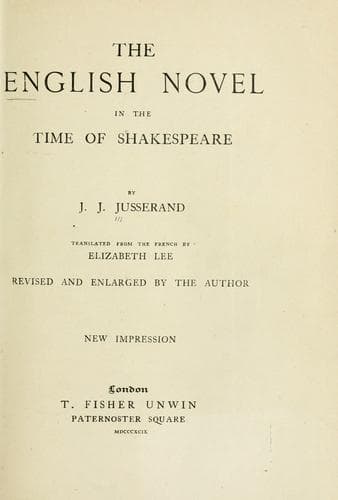
The English Novel in the Time of ShakespeareJusserand, J. J. (Jean Jules)
History
The English Novel in the Time of Shakespeare
Jusserand, J. J. (Jean Jules)
English fiction -- Early modern, 1500-1700 -- History and criticism
[357] Scarron's "Comical romance: or a facetious history of a company of
strowling stage-players," London, 1676, fol. Preface to the
continuation. The translator is at some pains to anglicize his original;
when Scarron speaks of Paris, the translator puts London; Ragotin is
heard defending Spenser (chapter xv.). The poet in Scarron brags of his
acquaintance with Corneille and Rotrou, and in the English text, with
Shakespeare, Fletcher, and Jonson (chap. viii.). There were other
translations of Scarron: "The whole comical works of M. Scarron,"
translated by Mr. T. Brown, Mr. Savage, and others, London, 1700, 8vo;
"The comic romance," translated by O. Goldsmith, Dublin, 1780(?) 2 vol.
12mo. His shorter novels or stories were separately translated by John
Davies, who states in the preface of "The unexpected Choice," London,
1670, that he did so at the suggestion of the late Catherine Philips,
the matchless Orinda.
[358] "The extravagant Shepherd, the anti-romance, or the history of the
shepherd Lysis," London, 1653, another edition 1660. Strange to say,
besides some adaptations from Spanish authors ("La Picara," 1665; "Donna
Rosina," 1700?), a translation of Voiture's Letters, 1657, the same John
Davies of Kidwelly, who had written this eloquent appeal against
heroical romances, translated "Clelia," 1656, and part of "Cleopatra" in
conjunction with Loveday.
[359] See also in Furetiere's "Roman bourgeois" how the reading of
"Astree" made of Javotte "la plus grande causeuse et la plus coquette
fille du quartier" (Ed. Janet, i. p. 173).
[360] "The Adventures of Covent Garden, in imitation of Scarron's city
romance," London, 1699, 16mo. "Scarron" is here evidently for
"Furetiere." This work, the author of which is unknown, has long been
forgotten, though deserving a better fate. It is dedicated "to all my
ingenious acquaintance at Will's coffee-house."
[361] _Cf._ Moliere: "Je voudrais bien savoir si la grande regle de
toutes les regles n'est pas de plaire, et si une piece de theatre qui a
attrape son but n'a pas suivi un bon chemin.... Laissons nous aller de
bonne foi aux choses qui nous prennent par les entrailles et ne
cherchons point de raisonnements pour nous empecher d'avoir du plaisir"
("Critique de l'Ecole des Femmes," sc. 7).
[362] "Double Dealer," by Congreve; "Plot and no Plot," by Dennis;
"Beauty in distress," by Motteux.
[363] By T. D., perhaps T. Duffet (Bullen), London, Bentley, 1676, 12mo.
[364] From his "Histoire d'Alcidalis et Zelide." Voiture had begun it in
1633 in the style fashionable at the Hotel de Rambouillet, and even, as
he pretends, with the help of Mdlle. de Rambouillet, to whom it is
dedicated. It was left unfinished and was published after his death,
being completed by Desbarres. A regular translation of it was published
in English in 1678.
Public-domain text, read in full here on John Shaqi.
Reviews
Reviews
No reviews yet
Be the first to share your thoughts on this work.
Elsewhere in the archive
Join the Discussion
Join the discussion
Sign in to leave a comment or review.
Sign InorCreate an account