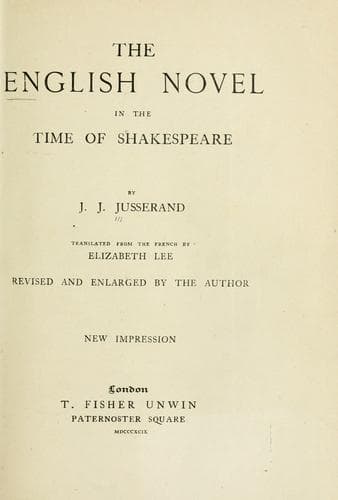
The English Novel in the Time of ShakespeareJusserand, J. J. (Jean Jules)
History
The English Novel in the Time of Shakespeare
Jusserand, J. J. (Jean Jules)
English fiction -- Early modern, 1500-1700 -- History and criticism
When the armour, worn less often, began to grow rusty in the great
halls, and the nobles, coming forth from their coats-of-mail like the
butterfly from the chrysalis, showed themselves all glistening in silk,
pearls in their ears, their heads full of Italian madrigals and
mythological similes, a new society was formed, salons of a kind were
organized, and the role of the women was enlarged. English mediaeval
times had been by no means sparing of compliments to them. But there is
a great difference between celebrating in verse fair, slim-necked
ladies, and writing books expressly for them: and it is one of the
points in which, during the Middle Ages and even until the middle of the
sixteenth century, England differed from the nations of the south. In
England no Lady Oisille had gathered round her in the depth of green
valleys tellers of amorous stories; no thickly-shaded parks had seen
Fiammettas or Philomenas listening to all kinds of narratives, forgetful
of the actual world and its sorrows. The only group of story-tellers,
bound together by a true artist's fancy, Chaucer's pilgrims, had ridden
in broad daylight on the high road to Canterbury, led by Harry Bailly,
the jovial innkeeper of Southwark, a blustering, red-faced dictator, who
had regulated the pace of the nags, and silenced the tedious babblers:
very different in all things from Fiammetta and the Lady Oisille.
Under the influence of Italy, France and mythology, the England of the
Tudors, changed all that. Women appeared in the foreground: a movement
of general curiosity animated the age, and they participated in it quite
naturally. They will become learned, if necessary, rather than remain in
the shade; they will no longer rest contented with permission to read
books written for their fathers, brothers, lovers, or husbands; some
must be written especially on their account, consulting their
preferences and personal caprices; and they had good reason to command:
one of them sat on the throne.
They, too, began to read Greek, Latin, Italian and French; knowledge was
so much the fashion that it extended to women. Here Ascham bears
testimony in their favour; the Queen herself gives the example: "She
readeth now at Windsore more Greeke every day than some prebendarie of
this chirch doth read Latin in a wole weeke."[54] In this she has
innumerable imitators, so much so that Harrison sums up as follows his
judgment concerning English ladies: "To saie how many gentlewomen and
ladies there are, that beside sound knowledge of the Greeke and Latin
toongs are thereto no lesse skilfull in the Spanish, Italian and French
or in some one of them, it resteth not in me."[55]
Public-domain text, read in full here on John Shaqi.
Reviews
Reviews
No reviews yet
Be the first to share your thoughts on this work.
Join the Discussion
Join the discussion
Sign in to leave a comment or review.
Sign InorCreate an account