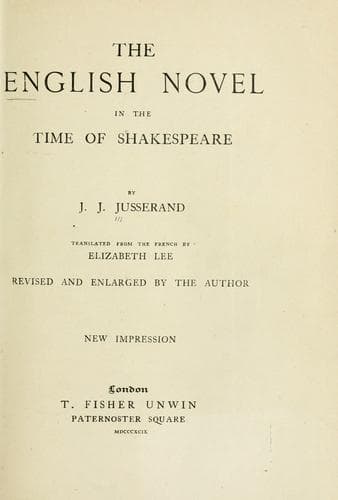
The English Novel in the Time of ShakespeareJusserand, J. J. (Jean Jules)
History
The English Novel in the Time of Shakespeare
Jusserand, J. J. (Jean Jules)
English fiction -- Early modern, 1500-1700 -- History and criticism
The Italian and French languages were held in great honour; both were
taught at Oxford and Cambridge; the latter especially was of common use
in England, and this peculiarity attracted the notice of foreigners. "As
regards their manners and mode of living, ornaments, garments and
vestments," writes the Greek Nicander Nucius, in 1545, "they resemble
the French more than others, and, for the most part, they use their
language."[50] But besides these elegant languages, Greek and Latin were
becoming courtly. They were taught in the schools and out of the
schools; the nobles, following the example of King Henry VIII. and his
children, made a parade of their knowledge. Ignorance was no longer the
fashion, no more than the old towers without windows. The grave Erasmus
went to hear Colet, the Dean of St. Paul's, and "he thought he was
hearing Plato"; Sir T. More, according to Erasmus, is the "sweetest,
softest, happiest genius nature has ever shaped." In a word, "literature
is triumphant among the English. The king himself, the two cardinals,
almost all the bishops, favour with all their soul and adorn
Letters."[51] To learn Greek and Latin was to move with the times and to
follow the fashion. "All men," says Ascham, less displeased with this
novelty than with the travelling propensities of his compatriots,
"covet to have their children speake latin"; and "Sophocles and
Euripides are more familiar now here than Plautus was formerly."[52]
Dazzled by what he saw and heard, Erasmus was announcing to the world in
enthusiastic letters that "the golden age" was to be born again in this
fortunate island.[53] His only regret was that he would perhaps not live
long enough to see it. Well might he regret it, even though it were not
to follow exactly as he had foreseen; for the golden apple of the golden
age was not to be plucked in the Greek Hesperides' garden, but in a
plain Warwickshire orchard: nor was it the less golden.
This fermentation of mind lasted for more than a century; lives were
often shortened by it, but they had been doubly well filled. From this
restless curiosity, bent towards past ages and foreign countries,
towards everything that was remote, unknown and different, came that
striking appearance of omniscience and universality, and that prodigious
wealth of imagery, allusions and ideas of every kind that are to be
found in all the authors of that time, small as well as great, and which
unites in one common bond Rabelais and Shakespeare, Cervantes and Sidney
and the "master of the enchanters of the ear," Ronsard.
Public-domain text, read in full here on John Shaqi.
Reviews
Reviews
No reviews yet
Be the first to share your thoughts on this work.
Join the Discussion
Join the discussion
Sign in to leave a comment or review.
Sign InorCreate an account