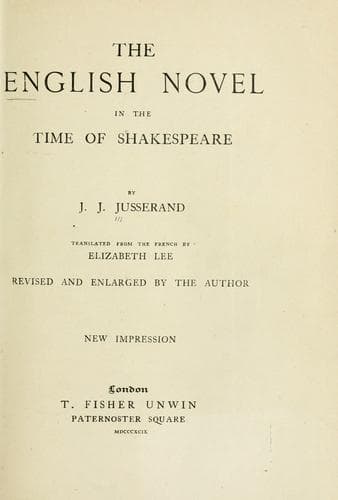
The English Novel in the Time of ShakespeareJusserand, J. J. (Jean Jules)
History
The English Novel in the Time of Shakespeare
Jusserand, J. J. (Jean Jules)
English fiction -- Early modern, 1500-1700 -- History and criticism
[45] "The historie of ... Plasidas and other rare pieces," ed. H. H.
Gibbs, Roxburghe Club, London, 1873, 4to. One of these "pieces,"
prefaced with an important introduction, is the "Goodli history" of Lady
Lucrece.
[46] _Ut supra_, p. 119.
[47] Here is Piccolomini's text: "Sed ut ipse Caesarem, sic eum Lucretia
sequebatur in somnis, nullamque noctem sibi quietam permittebat. Quam ut
obiisse verus amator cognovit, magno dolore permotus, lugubrem vestem
recepit; nec consolationem admisit, nisi postquam Caesar ex ducalo
sanguine virginem sibi cum formosam tum castissimam atque prudentem
matrimonio junxit." The French translator did not alter this end. It
will be remembered that the conclusion of Chaucer's "Troilus" compares
in the same way with Boccaccio's and with the French translator's,
Pierre de Beauveau.
[48] "Captain Cox, his ballads and books, or Robert Laneham's Letter ...
1575," ed. F. J. Furnivall, London, Ballad Society, 1871, 8vo, p. 29.
[49] Epistle to the reader, prefacing the "Palace of Pleasure."
[50] That there was also in London a public for Italian books is shown,
among many other proofs, by the early publication thereof an edition of
the "Pastor Fido" of Guarini in the original, London, 1591, 12mo.
[51] "Epistolarum ... libri xxxi.," London, 1642, fol., col. 308, 533,
364, &c. A.D. 1497 and 1519.
[52] "The Scholemaster," p. 2, and Letter to Brandesby (in Latin),
1542-3; "Works," ed. Giles, tom. i. p. 25.
[53] "Equidem aureum quoddam seculum exoriri video, quo mihi fortassis
non continget frui, quippe qui jam ad fabulae meae catastrophem accedam"
(Letter to Henry of Guildford, May, 1519, "Epistolarum ... libri xxxi.,"
London, 1642, fol., col. 368)
[54] "The Scholemaster," p. 21.
[55] "Description of Britaine," 1577, ed. Furnivall, New Shakspere
Society, part i, p. 271.
[56] "Est praeterea mos nunquam satis laudatus. Sive quo venias omnium
osculis exciperis; sive discedas aliquo, osculis dimitteris; redis,
redduntur suavia ... denique quocumque te moveas, suaviorum plena sunt
omnia" ("Epistolarum ... libri.," London, 1642, col. 315, A.D. 1499).
[57] "The second book of the travels of Nicander Nucius," ed. Cramer,
London, Camden Society, 1841, 4to, p. 10. Nucius resided in England in
1545-6.
[58] "The Memoires of Sir James Melvil, of Hal-hill," ed. G. Scott.
London, 1683, fol. p. 47.
[59] The autograph manuscript of her translations, which comprise a part
of the works of Plutarch, Horace and Boetius, was found in 1883, at the
Record Office.
[60] "Memoires," London, 1683, pp. 49 _et seq._
[61] "Travels in England," ed. H. Morley, London, 1889, p. 47.
[62] "Antony and Cleopatra," act ii. sc. 5. As for a reproduction of
Rogers' engraving, see Frontispiece of this volume.
Public-domain text, read in full here on John Shaqi.
Reviews
Reviews
No reviews yet
Be the first to share your thoughts on this work.
Elsewhere in the archive
Join the Discussion
Join the discussion
Sign in to leave a comment or review.
Sign InorCreate an account