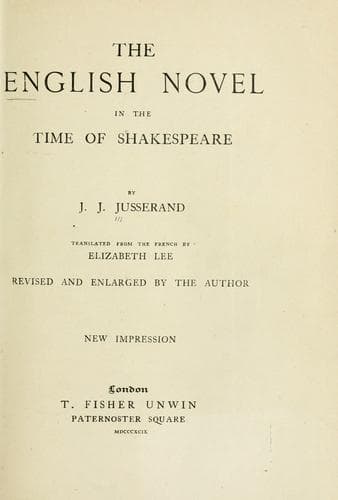
The English Novel in the Time of ShakespeareJusserand, J. J. (Jean Jules)
History
The English Novel in the Time of Shakespeare
Jusserand, J. J. (Jean Jules)
English fiction -- Early modern, 1500-1700 -- History and criticism
[63] An album of sketches of this sort, made by Inigo Jones while in
Italy, 1614, was reproduced in fac-simile by the care of the Duke of
Devonshire, London, 1832. See also drawings, by the same, for scenery
and costumes in masks in the "Portfolio," May, June, and July, 1889,
three articles by Mr. R. T. Blomfield. Isaac Oliver the famous
Elizabethan miniature painter, has left also drawings, one of which is
reproduced at the head of this chapter, testifying to his careful study
of Italian models.
[64] A view of this court, with the caryatides, is to be seen in W.
Kent, "The Designs of Inigo Jones," London, 1835, two vol. fol. We give
a reproduction of the caryatides.
[65] It was built on the plans, as is supposed, of J. Thorpe, possibly
with the help of the Italian John of Padua. Above one of the doors of
the inner court is the date 1577; the clock tower is dated 1585; see the
engraving p. 69. Hatfield bears on its facade the date 1611. Audley End
was built 1603-1616.
[66] "Description of Britaine," ed. Furnivall, New Shakspere Society,
part i. pp. 268 and 338.
[Illustration: A DRAGON, ACCORDING TO TOPSELL, 1608.]
CHAPTER III.
LYLY AND HIS "EUPHUES."
I.
The romance which, at this period, received a new life, and was to come
nearer to our novels than anything that had gone before, has many traits
in common with the fanciful style of the architecture, costume, and
conversation described above. What have we to do, thought men, with
things practical, convenient, or of ordinary use? We wish for nothing
but what is brilliant, unexpected, extraordinary. What is the good of
setting down in writing the incidents of commonplace lives? Are they not
sufficiently known to us? does not their triviality sadden us enough
every day? If we are told stories of imaginary lives, let them at least
be dissimilar from our own; let them offer unforeseen incidents; let the
author be free to turn aside from reality provided that he leaves the
trivial and the ordinary. Let him lead us to Verona, Athens, into
Arcadia, where he will, but as far as possible from Fleet Street! And if
by ill-luck he sets foot in Fleet Street, let him at least speak the
language of Arcadia!
Authors found this advice excellent, and took good care to relieve
themselves of difficult search after the mere truth. The public who
imposed these laws, this exacting public of women who read Plutarch and
Plato, who judged the merits of great men as learnedly as the cut of a
ruff, found at the very moment they most wanted him the author who could
please them in the person of a novel writer, the famous Lyly. At
twenty-five years of age, John Lyly, a _protege_ of Lord Burghley, who
was at this same time busy with his own architectural poem, if one may
say so, of Burghley House, wrote "Euphues,"[67] a new kind too of
"paper-work" with which people were enraptured.
Public-domain text, read in full here on John Shaqi.
Reviews
Reviews
No reviews yet
Be the first to share your thoughts on this work.
Elsewhere in the archive
Join the Discussion
Join the discussion
Sign in to leave a comment or review.
Sign InorCreate an account