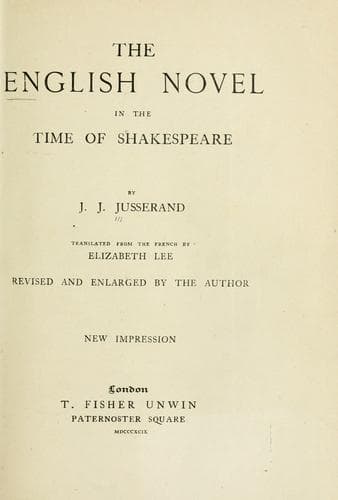
The English Novel in the Time of ShakespeareJusserand, J. J. (Jean Jules)
History
The English Novel in the Time of Shakespeare
Jusserand, J. J. (Jean Jules)
English fiction -- Early modern, 1500-1700 -- History and criticism
Such being the current belief among students of the natural sciences, we
may be the better prepared to excuse some eccentricities in a novelist.
Lyly, who was well versed in the legendary lore of plants and animals,
is never tired of making a display of his knowledge, but the wonder is
that his readers had never too much of that. A single erudite or
scientific simile never satisfies Lyly; he has always in his hands a
long bead-roll of them, which he complacently pays out: "The foul toade
hath a faire stone in his head, the fine golde is found in the filthy
earth: the sweet kernell lyeth in the hard shell: vertue is harboured in
the heart of him that most men esteeme mishapen ... Doe we not commonly
see that in painted pottes is hidden the deadlyest poyson? that in the
greenest grasse is ye greatest serpent? in the cleerest water the
uglyest toade?" and four or five similes still follow. Tormented by
examples, overwhelmed with similitudes, the adventurous reader, who
to-day risks a reading of "Euphues," feels it impossible to keep his
composure. He would like to protest, to defend himself, to say that he
has lied, this imperturbable naturalist, that bitter kernels are found
indeed in the hardest shells, that painted pots often contain something
other than poison, and that if toads appear less ugly in foul water, it
is perhaps because they are the less seen. But what does it matter to
Lyly? He writes for a select coterie, and when a man writes for a
coterie, the protestations of the discontented, of the envious, alas! of
those of good sense, too, are scarcely of any consequence. Let the
common herd then shriek themselves hoarse at Lyly's door: it is shut
fast, he will hear nothing, and is indifferent even if among this common
herd Shakespeare figures. He is happy; "Euphues," in company with the
little dogs, rumples the silken laps of ladies with the lace-plaited
ruffs.
[Illustration: THE BOA, AS IT WAS UNDERSTOOD, A.D. 1608.]
III.
Public-domain text, read in full here on John Shaqi.
Reviews
Reviews
No reviews yet
Be the first to share your thoughts on this work.
Elsewhere in the archive
Join the Discussion
Join the discussion
Sign in to leave a comment or review.
Sign InorCreate an account