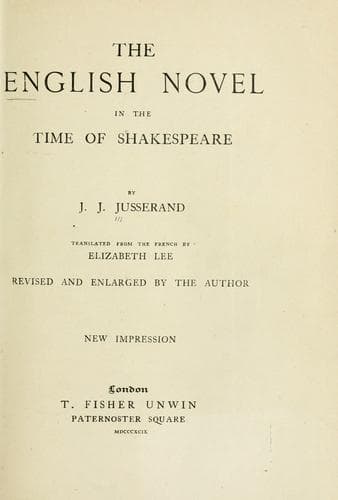
The English Novel in the Time of ShakespeareJusserand, J. J. (Jean Jules)
History
The English Novel in the Time of Shakespeare
Jusserand, J. J. (Jean Jules)
English fiction -- Early modern, 1500-1700 -- History and criticism
All Lyly's imitators, Greene, Lodge, Melbancke, Riche, Munday, Warner,
Dickenson, and others, did not faithfully copy his style in all its
peculiarities, at any rate in all their works; some of them borrowed
only his ideas, others his plot; others his similes; most of them,
however, when they first began to write, went the fullest length in
imitation, and tricked themselves out in euphuistic tinsel. They were
careful by choosing appropriate titles for their novels to publicly
connect themselves with the euphuistic cycle. "Euphues" was a magic
pass-word, and they well knew that the name once pronounced, the doors
of the "boudoirs," or closets as they were then called, and the hands
of the fair ladies, were sure to open; the book was certain to be
welcome.
Hence the number of writers who declared themselves Euphues' legatees
and executors. Year after year, for a while, readers saw issuing from
the press such books as "Zelauto, the fountaine of Fame ... containing a
delicate disputation ... given for a friendly entertainment to Euphues
at his late arrival into England," by Munday, 1580; or as "Euphues his
censure to Philautus, wherein is presented a philosophicall combat
betweene Hector and Achylles," by Robert Greene, 1587: "Gentlemen," says
the author to the readers, "by chance, some of Euphues loose papers came
to my hand, wherein hee writ to his friend Philautus from Silexedra,
certaine principles necessary to bee observed by every souldier." Or
there was "Menaphon, Camillas alarum to slumbering Euphues," by the
same, 1589; "Rosalynde, Euphues golden legacie, found after his death in
his cell at Silexedra," by Thomas Lodge, 1590; "Arisbas, Euphues amidst
his slumbers," by John Dickenson, 1594, &c.[103] All these authors
continued their model's work in contributing to the development of
literature written chiefly for ladies; in that way especially was Lyly's
initiative fruitful.
Public-domain text, read in full here on John Shaqi.
Reviews
Reviews
No reviews yet
Be the first to share your thoughts on this work.
Elsewhere in the archive
Join the Discussion
Join the discussion
Sign in to leave a comment or review.
Sign InorCreate an account