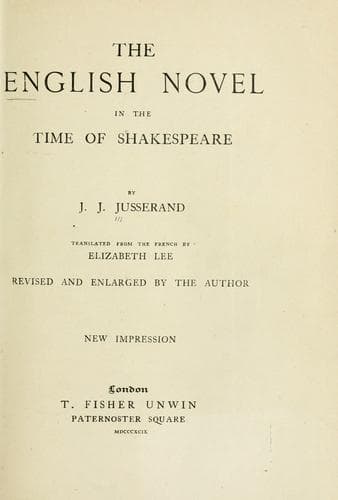
The English Novel in the Time of ShakespeareJusserand, J. J. (Jean Jules)
History
The English Novel in the Time of Shakespeare
Jusserand, J. J. (Jean Jules)
English fiction -- Early modern, 1500-1700 -- History and criticism
When Warner spoke, apparently, of Greene as a "scholler" better than
himself he was quite right, and as a matter of fact, Lyly's two most
famous disciples were Thomas Lodge, a friend of Riche, who helped him to
revise his works and corrected his faulty verses, and Robert Greene, a
novelist and dramatist like Lodge and Lyly, and a friend of the former.
Endowed with a less calm and sociable temperament than their model,
Greene and Lodge led a chequered existence very characteristic of their
epoch.
II.
With Robert Greene we are in the midst of Bohemia, not exactly the
Bohemia which Muerger described and which dies in the hospital: the
hospital corresponds in some manner to ideas of order and rule; under
Elizabeth men remained irregular to the end; literary men who were not
physicians like Lodge, or shareholders in a theatre like Shakespeare, or
subsidized by the Court like Ben Jonson, died of hunger in the gutter,
or of indigestion at a neighbour's house, or of a sword-thrust in the
tavern. Therein is one of the peculiarities of the period. It
distinguishes the Bohemia of Elizabeth from other famous Bohemias, that
of Grub Street, known to Dr. Johnson, and that of the _quartier latin_
described by Muerger.
Greene was one of the most original specimens of the unfortunate men who
in the time of Elizabeth attempted to live by their pen. He was as
remarkable for his extravagances of conduct as for his talents,
sometimes gaining money and fame by the success of his writings,
sometimes sinking into abject poverty and consorting with the outcasts
of society. Of all the writers of the Elizabethan period he is perhaps
the one whose life and character we can best picture to ourselves; for
in his last years, repentant and sorrow-stricken, he wrote with the
utmost sincerity autobiographical tales and pamphlets, which are
invaluable as a picture of the times; they are, in fact, nothing else
than the "Scenes de la vie de Boheme" of Elizabethan England.
Public-domain text, read in full here on John Shaqi.
Reviews
Reviews
No reviews yet
Be the first to share your thoughts on this work.
Elsewhere in the archive
Join the Discussion
Join the discussion
Sign in to leave a comment or review.
Sign InorCreate an account