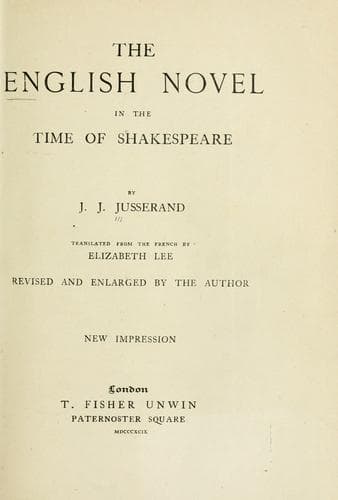
The English Novel in the Time of ShakespeareJusserand, J. J. (Jean Jules)
History
The English Novel in the Time of Shakespeare
Jusserand, J. J. (Jean Jules)
English fiction -- Early modern, 1500-1700 -- History and criticism
This story, characteristic as it is of Greene's style when he means to
be euphuistic, can scarcely be taken as a fair sample of the
improbability he is able to crowd into a single novel. Most of his tales
(and in this he greatly differs from Lyly) take place we do not know
when, we do not know where, among men we have never anywhere come
across. Learned as he was, versed in the Greek, Latin, French and
Italian tongues, able to translate passages from the Italian of Ariosto,
to dress in English language the charming "Debat de Folie et
d'Amour"[134] of Louise Labe, to imitate (as he thought) Cicero's style,
while describing (as he thought) the great orator's loves,[135] his turn
of mind was as little critical as can be imagined, and his wide
popularity served to spread geographical and historical absurdities,
some of which were preserved by Shakespeare himself, for the amusement
of a learned posterity. Greene's picture of Ulysses' Penelope is not
more Greek than the exquisite painting by Pinturicchio at the National
Gallery, where the wise king of Ithaca appears under the guise of a
red-hosed Italian youth with flowing hair; while his wife sits at her
"web" in a Florentine blue dress. In Greene, Penelope is represented
telling stories to while away the time, which, unless we endow her with
a prophetical gift, are impossibilities. Her first story begins thus:
"Saladyne the Souldan of AEgipt, who by his prowesse had made a generall
conquest of the south-east part of ye world tooke to wife Barmenissa,
the onely daughter and heire of the great chan." No wonder that such
tales could chain the attention and awaken the curiosity of her maids,
and keep them quiet till the time when "a messenger came hastily rushing
in, who tolde Penelope that Ulisses was arryved that night within the
port of Ithaca.... Penelope called for her sonne and that night sent him
post to the sea."[136]
Not less wonderful are the stories of "Arbasto," King of Denmark, or of
"Pandosto," King of Bohemia. They may be taken as typical specimens of
the sort of romantic novel the Elizabethan public enjoyed, and which was
sure to make an author popular. We must remember when reading these
tales that they were the fashion, the craze, at a time when "Midsummer
Night's Dream" and "Romeo and Juliet" were being played. Chaotic,
improbable, and in some parts ridiculous as they appear to us, they
would have made their author wealthy if anything could, so much so that,
as we have seen, the publishers, according to Nash, considered
themselves "blest to pay Greene deare for the very dregs of his wit." He
was, if anything, an author that sold. What were his wares?
Public-domain text, read in full here on John Shaqi.
Reviews
Reviews
No reviews yet
Be the first to share your thoughts on this work.
Elsewhere in the archive
Join the Discussion
Join the discussion
Sign in to leave a comment or review.
Sign InorCreate an account