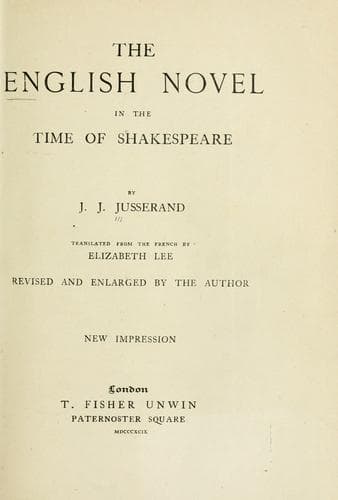
The English Novel in the Time of ShakespeareJusserand, J. J. (Jean Jules)
History
The English Novel in the Time of Shakespeare
Jusserand, J. J. (Jean Jules)
English fiction -- Early modern, 1500-1700 -- History and criticism
The events of the story take place among kings and shepherds: "In the
countrey of Bohemia there raygned a king called Pandosto." This is the
usual beginning of novels of the time; hundreds of them commence in this
manner;[137] the very first lines transport the reader to an unknown
country, and place him before an unknown king, and if, after reading
only those few words, he is surprised to find himself entangled in
extraordinary, inexplicable adventures, he must be of a very naive
disposition. But in Elizabethan times adventures were liked for their
own sake; probability was only a very secondary motive of enjoyment.
"Pandosto," in any case, deserves our attention, for, if it commenced
like many other novels of the time, it led, as we have said, to
"Winter's Tale," to which it is worth while to go. When the two are read
together and compared, it seems as if Shakespeare had chosen on purpose
one of the worst of Greene's tales, to show by way of an answer to the
accusations of the dead writer, that he was able to form something out
of nothing. Greene had, in truth, only modelled the clay; Shakespeare
used it, adding the soul.
Greene simply states his facts and takes little trouble about explaining
them; the reader must rest satisfied with the author's bare word. There
is no attempt at the study of passions; his heroes change their minds
all of a sudden, with the stiff, sharp, improbable action of puppets in
a show. Pandosto (Leontes) loves and hates, and becomes jealous, and
repents always in the same brusque wire-and-wood manner; the warmth of
his passions, so great and terrible in Shakespeare, is here simply
absent; when he begins to suspect his friend Egistus (Polixenes) of
feeling an unlawful love for Bellaria (Hermione), we are barely informed
that the Bohemian king "concluded at last to poyson him." When Dorastus
and Fawnia (Florizel and Perdita) seek refuge in Pandosto's kingdom,
Pandosto at once falls in love with his own daughter, Fawnia, whom he
does not know; then on the receipt of a letter from Egistus, "having his
former love turned to a disdainful hate," he wishes to have her killed.
Very differently is the couple received by Shakespeare's Leontes:
"Were I but twenty-one,
Your father's image is so hit in you,
His very air, that I should call you brother,
As I did him; and speak of something wildly
By us performed before. Most dearly welcome!
And you, fair princess, goddess!--O, alas,
I lost a couple, that 'twixt heaven and earth
Might thus have stood, begetting wonder as
You gracious couple do."
Public-domain text, read in full here on John Shaqi.
Reviews
Reviews
No reviews yet
Be the first to share your thoughts on this work.
Elsewhere in the archive
Join the Discussion
Join the discussion
Sign in to leave a comment or review.
Sign InorCreate an account