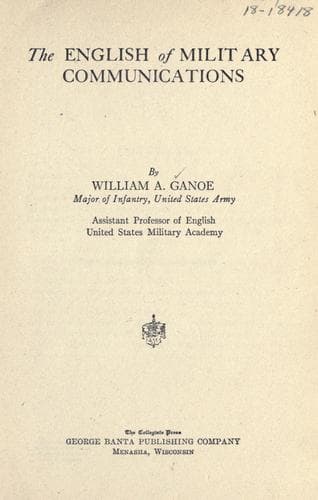
The English of military communicationsGanoe, William Addleman
History
The English of military communications
Ganoe, William Addleman
English language -- Rhetoric; Military orders; United States. Army -- Records and correspondence
A more narrative form of report is represented by the following
extract from Gen. Bragg’s report during the Civil War:
“To meet our successful advance and retrieve his losses in the
front of his left, the enemy early transferred a portion of his
reserve from his left to that flank, and by 2 o’clock had succeeded
in concentrating such a force on Lieutenant General Hardee’s front
as to check his further progress. Our two lines had, by this time,
become almost blended, so weak were they by losses, exhaustion,
and extension to cover the enemy’s whole front. As early as 10
a. m. Major General Breckinridge was called on for one brigade,
and soon after for a second, to reinforce or act as a reserve to
General Hardee. His reply to the first call represented the enemy
as crossing Stone’s River in heavy force in his immediate front;
and on receiving the second order he informed me they had already
crossed in heavy force and were advancing on him in two lines. He
was immediately ordered not to wait attack but to advance and meet
them. About this same time a report reached me that a heavy force
of the enemy’s infantry was advancing on the Lebanon Road about
five miles in Breckinridge’s front. Brigadier General Pegram, who
had been sent to that road to cover the flank of the infantry with
the cavalry brigade (save two regiments, detached with Wheeler
and Wharton), was ordered forward immediately to develop such
movement. The orders for the two brigades from Breckinridge were
countermanded, whilst dispositions were made at his request to
reinforce him. Before they could be carried out, the movements
ordered disclosed the facts that no force had crossed Stone’s
River; that the only enemy in our immediate front there was a small
body of sharpshooters, and that there was no advance on the Lebanon
Road.
“These unfortunate misapprehensions on that part of the field
(which, with proper precaution, could not have existed) withheld
from active operation three fine brigades until the enemy had
succeeded in checking our progress, had reëstablished his lines,
and had collected many of his broken battalions.”
The above example, in addition to its value as a narrative report,
illustrates the dependence of a commander upon proper information.
ROUTINE ORDERS
Routine Orders preserve their normal tenor in peace or war. They have
to do with the administration of the military service, so that a
state of campaign has very little influence upon their character.
{ General Orders.
{ Special Orders.
They consist of { Circulars.
{ Bulletins.
{ Memoranda.
Public-domain text, read in full here on John Shaqi.
Reviews
Reviews
No reviews yet
Be the first to share your thoughts on this work.
Elsewhere in the archive
Join the Discussion
Join the discussion
Sign in to leave a comment or review.
Sign InorCreate an account