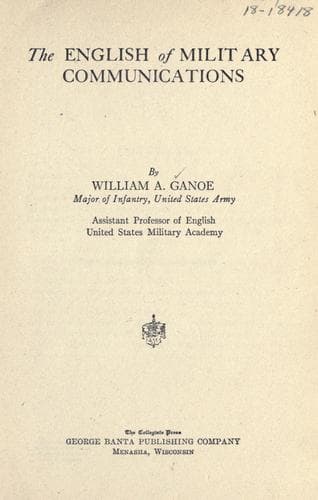
The English of military communicationsGanoe, William Addleman
History
The English of military communications
Ganoe, William Addleman
English language -- Rhetoric; Military orders; United States. Army -- Records and correspondence
Should one or more additional sheets be necessary for the _Body_ or
_Indorsements_, sheets of the same size as the first will be added.
Only one side of the paper will be used for writing.
Indorsements of a routine nature such as referring, transmitting,
forwarding, and returning papers, will not be signed with the full
name, but with initials.
When the letter of the Department Commander to Captain Douglas
reaches the Commanding Officer, Madison Barracks, N. Y., who is also
Commanding Officer, 99th Infantry, the latter may do either of two
things. He may simply forward the letter to Captain Douglas without
comment, because he deems the letter sufficient for the purpose; or
he may add a disciplinary word also.
In the first case the indorsement would appear as follows:
1st Ind.
Hq. 99th Inf., Madison Barracks, N. Y., May 23, 1940—To
Captain James L. Douglas, 99th Inf., Forwarded,
A. D. T.
In the second case the indorsement would appear as follows:
1st Ind.
Hq. 99th Inf., Madison Bks., N. Y., May 23, 1940—To
Captain James L. Douglas, 99th Inf.
For compliance.
By order of Colonel Maish,
A. D. Thomas,
Capt. 99th Inf.,
Adjutant.
The _Body_ and _Indorsements_ of letters are signed by the Adjutant
when the letters are addressed to those lower in rank than the
Commanding Officer. They are signed by the Commanding Officer himself
when addressed to those higher in rank than the Commanding Officer.
Letters are never addressed to adjutants.
In connection with indorsements it might be well to quote what Army
Regulations say in their regard.
“Communications, whether from a subordinate to a superior, or
vice versa, will pass through intermediate commanders. This rule
will not be interpreted as including matters in relation to which
intermediate commanders can have no knowledge, and over which they
are not expected to exercise control. Chiefs of War Department
bureaus are intermediate commanders between higher authority and the
officers and enlisted men of their respective corps or departments,
who are serving under the exclusive control of themselves and their
subordinates. Verbal communications will be governed by the same
rules as to channels as written communications. When necessity
requires communications to be sent through other than the prescribed
channel, the necessity therefor will be stated.
Communications from superiors to subordinates will be answered
through the same channels as received.
Except as provided above, all communications, reports, and estimates
from officers serving at a military post, and communications of every
nature addressed to them relating to affairs of the post, will pass
through the post commander.
Public-domain text, read in full here on John Shaqi.
Reviews
Reviews
No reviews yet
Be the first to share your thoughts on this work.
Elsewhere in the archive
Join the Discussion
Join the discussion
Sign in to leave a comment or review.
Sign InorCreate an account