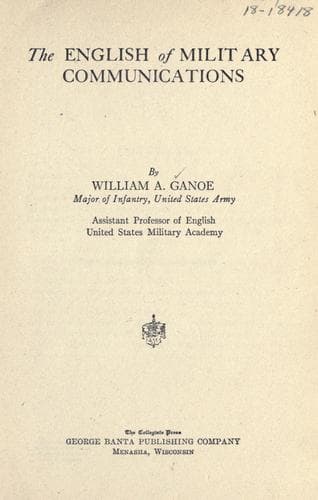
The English of military communicationsGanoe, William Addleman
History
The English of military communications
Ganoe, William Addleman
English language -- Rhetoric; Military orders; United States. Army -- Records and correspondence
5. The detachment commander
will be with the
main body until 7 a. m.,
(d) Signal Troops: and thereafter with the advance
Lieut. Dash. guard.
1 plat. Co. A.
By order of Brig.-Gen. Forse:
J. G. HAMILTON,
Lt. Col., 1st Inf.,
_Acting Chief of Staff_.
Copies to Colonels Adams and Byron, commanders of artillery
and engineers, and to staff; to division commander by wire.
There are certain
SPECIAL CAUTIONS
in regard to the writing of the field order.
1.—What is required in paragraph 3 of the _Body_ is that the order be
logical—coherent.[13]
2.—An order tells a subordinate _what_ to do but not _how_ to do it.
3.—Conjectures, expectations, reasons for measures adopted, and
detailed instructions for a variety of possible events, do not
inspire confidence, and should be avoided.
4.—As a rule, an affirmative form of expression is used. Such an
order as: “The supply train will not accompany the division,” is
defective, because the gist of the order depends upon the single word
“not.” It is far better to say, “The supply train will remain at
so-and-so until further orders.”
5.—Do not use such expressions as “attempt to capture,” “try to
hold,” “as far as possible,” “as well as you can.” Besides being
indefinite, they divide responsibility. You, for example, receive
an order “to try to capture” a certain position. Immediately there
pops into your mind the suspicion that the commanding officer did
not believe that the place could be taken, or was not anxious about
having it captured. The commanding officer by the very wording of
his order has taken on himself a part of the responsibility in the
event of a repulse. At least he has not placed all the burden of
the undertaking upon you. In the latter case he has been guilty of
improper subordination.
CHAPTER VII
PROBLEMS IN THE FIELD ORDER
After the plan of Trench of the English Service, we are going to
take up the problems in the construction of the field order along
the lines on which tactical situations naturally develop themselves
during hostilities. We shall discover that the sequence will not only
conform to actual conditions, but will lead from the more simple to
the more complex. We shall, then, proceed with,—
(1) The March Order.
(2) The Attack Order.
(3) The Order for Position in Readiness.
(4) The Defense Order.
(5) The Retreat Order.
(6) The Pursuit Order.
(7) The Halt Order.
(8) The Outpost Order.
Emphasis will be laid upon the march and attack orders, because they
are the most usual and the most critical.
Public-domain text, read in full here on John Shaqi.
Reviews
Reviews
No reviews yet
Be the first to share your thoughts on this work.
Join the Discussion
Join the discussion
Sign in to leave a comment or review.
Sign InorCreate an account