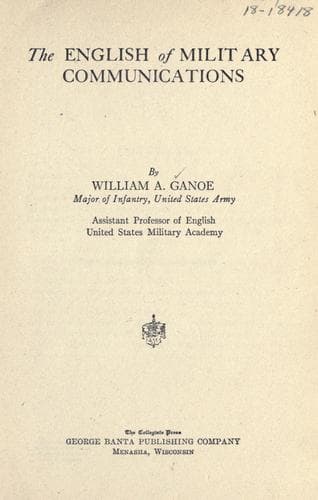
The English of military communicationsGanoe, William Addleman
History
The English of military communications
Ganoe, William Addleman
English language -- Rhetoric; Military orders; United States. Army -- Records and correspondence
In these problems all necessary data will be given. No attempt will
be made to mislead in regard to fact. But every attempt will be made
to mislead in regard to the expression of the fact. Crude violations
and mixtures of rhetoric will therefore be found throughout.
In arranging his material the student should use his own style and
should not attempt to copy phraseology from any military forms. _That
which is most brief and most unmistakable is best, no matter who
writes the order._
_Note._—The topographical data will not be found upon the map. The
units for which a field order must be written require an area larger
than that which our limited sheet provides. The student, by reading
over the problem two or three times ought, with the aid of his
imagination, to perceive the will of the commander.
(1) MARCH ORDERS
1.—On June 12, 1925, you are Major General Abercrombie in command of
the 16th Division of the 12th Army Corps. You wish your division,
which is in the vicinity of Bruceville, to march over to Littlestown
the next day. You want it to cover the base and line of supply for
your troops. You want it to do all this because one of your flying
corps lieutenants saw from a captive balloon about a division of
the enemy pass through Chambersburg early in the morning. The enemy
was marching east and according to the lieutenant was composed of
infantry, cavalry, field artillery—in fact, all branches of the
service. You finish with this your twenty-second order since January
1st at a quarter after ten at night. But just before you finish with
your order a Colonel of Cavalry on your staff tells you that he
personally saw cavalry in Gettysburg during the evening. You want
your advance guard, which consists of the 1st Brigade, 1st Battalion
of the 1st Field Artillery, Company A, First Battalion of Engineers,
one section of a Signal Company, and the first ambulance company, to
get past the bridge over Pipe Creek at precisely six o’clock and to
go along the main road to Littlestown in its route. The advance guard
is to be commanded by Brigadier General Black. Now the main body,
you figure, will go along in column from front to rear,—one section
of the Signal Company, the fourth regiment of Infantry, the Field
Artillery Brigade without its combat train, the 2d Brigade without
the 4th Infantry, the third Brigade, the Signal Company (Company A)
without its detachments, the first Battalion of Engineers without
Company A, the Field Artillery Combat Train, and then the second,
third, and fourth Ambulance companies.
Public-domain text, read in full here on John Shaqi.
Reviews
Reviews
No reviews yet
Be the first to share your thoughts on this work.
Elsewhere in the archive
Join the Discussion
Join the discussion
Sign in to leave a comment or review.
Sign InorCreate an account