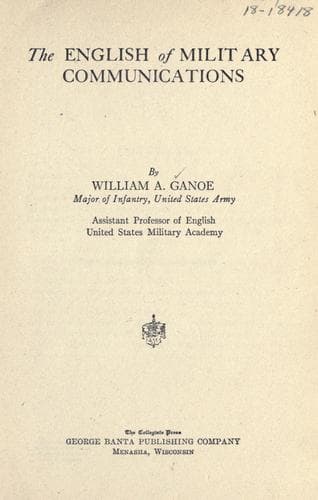
The English of military communicationsGanoe, William Addleman
History
The English of military communications
Ganoe, William Addleman
English language -- Rhetoric; Military orders; United States. Army -- Records and correspondence
10.—You are Brigadier General Aaron in charge of a detachment of the
1st Division. You are about to get out your fourth field order of the
campaign, which you issued and signed at ten minutes to seven on the
morning of October 6, 1918. Your Chief of Staff is Lieutenant Bean.
The main body, of which you are a part, is engaged with the enemy
at the present time. The two bodies opposed to each other, fighting
strenuously, extend from near the Belmont School House toward the
north. You want the 1st Infantry to advance via the 530-618 road,
and you want it to deploy whenever it is necessary for it to do so.
You want it to deploy with its left flank touching the 548-618 road.
After it has done this you want it to attack at the same time that
the 2d Infantry does. Your artillery you want to move out by way of
the road which runs through 542 and 550, and you want it to go so it
will get a position somewhere near the Hill 608; it will be escorted
by the 1st Battalion of the 2d Infantry. You want this artillery
to support the attack in the best way it can. The 1st Battalion
of the 2d Infantry should take up such formation and movement as
will best provide protection for the left of your whole line. The
whole of the 2d Infantry, of course, excepting the first battalion,
will advance by 452. It will then take a cut across country and
then by the road which goes by 546 and 548. The 2d Infantry will
attack the enemy’s right flank. The cavalry should cover the left
of your own troops and make strong reconnaissance of the country to
the north and also to the west. A troop of this Cavalry should be
sent over to the right flank of our troops. The work of this troop
should be to get into communication and keep communication with your
main army by telegraph. You want the Signal Detachment to give you
wire communications, or in fact, any kind of communications which
will best keep you in touch with the 1st Infantry. You are at the
cross-roads near Mt. Vernon School House when you write your order.
You have learned that there is a body of the enemy, a rather large
body in fact, which is going into some position selected near Granite
Hill. You gain from reliable patrols all the above information, and
also the fact that this detachment of the enemy is about one-half
your own strength. You decide that you are going to attack at once
this detachment which is just spoken of, which is going into a
position near Granite Hill. If it is going into position, and if it
is now only one-half your strength, you can see that there are two
reasons why you must launch your attack with the utmost vigor and
celerity, because the enemy might gain reinforcements, or a good
position in the meantime. You state in your order that you are going
to be with the reserve all the time, and you send copies to all your
officers, especially to Major Good who is commanding the cavalry, and
you report what you have done by telegraph to the Chief of Staff. You
Public-domain text, read in full here on John Shaqi.
Reviews
Reviews
No reviews yet
Be the first to share your thoughts on this work.
Elsewhere in the archive
Join the Discussion
Join the discussion
Sign in to leave a comment or review.
Sign InorCreate an account