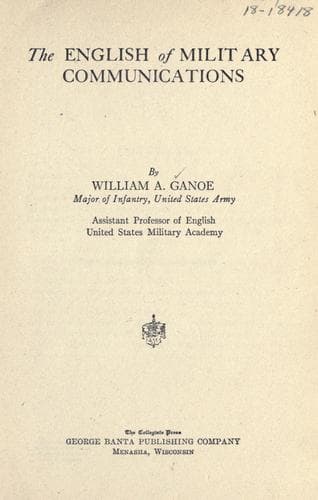
The English of military communicationsGanoe, William Addleman
History
The English of military communications
Ganoe, William Addleman
English language -- Rhetoric; Military orders; United States. Army -- Records and correspondence
and should pick out and mark points which are to be entrenched. Your
engineer battalion will start to march at the same hour as the other
troops mentioned above. They are to strike then across to Middleburg
and then they are to go to places which are to be picked out by the
chief of staff, and when they get to those places they are to assist
in the entrenching. You decide that you are going to go to Taneytown
and stay there until the outpost is withdrawn. You want the field
trains to start out at three o’clock in the morning, and these should
go along and follow in the course which has been already designated
for the respective units to which the field trains belong. These
field trains are to cross the Pipe Creek and are to assemble at
Woodsburg. All the other columns of the trains will start out at the
same hour as the troops. The ammunition columns and the two field
hospitals are to halt at Ladysburg; all the others halt at Woodsburg.
You issue this order at 10 o’clock in the evening and you sign it
yourself, and you send copies of this, your 10th field order of the
campaign, to all officers who come to your headquarters to receive
orders.
(4) THE DEFENSE ORDER
2.—You are Major General Standish. You have just received word that
the enemy to which you are opposed has been very heavily reenforced
and has now about two divisions in the town of Taneytown. Your main
army is not going to leave until the 19th, and then it will get as
far as Marshall probably. You are in command of the 21st division of
the 8th corps, and you are south of Emmitsburg on the 17th day of
May, 1945. You decide that you can’t do anything else but take up a
defensive position. You accordingly want to make your division occupy
a position extending from McKee Knob to the northeast. You want the
second brigade, which is going to be reenforced by the first cavalry
and also by the 2d battalion, 1st field artillery to cover this
movement, to take up a defensive position. General Calhoun of the
second brigade has to put in place of the infantry of his brigade on
the southern line of outpost, certain cavalry patrols. These cavalry
patrols will come from two corps which have been sent to General
Calhoun, or at least have been ordered to report to him at Motters
at one o’clock in the morning. General Calhoun should relieve the
outpost of the third brigade at two o’clock in the morning, and of
the first at three o’clock in the morning. The first brigade, after
its outpost is relieved, should immediately take up the march, going
up the road which runs through Emmitsburg and Liberty Hall School
House. It should halt when it gets northeast of 656. General Calhoun
has to be placed in command in order to carry out his part of the
situation as to certain other troops—in fact, the 2d battalion of the
1st field artillery, and the 1st cavalry, should now become a part
of his command. The 2d battalion of the 1st field artillery is at
Public-domain text, read in full here on John Shaqi.
Reviews
Reviews
No reviews yet
Be the first to share your thoughts on this work.
Elsewhere in the archive
Join the Discussion
Join the discussion
Sign in to leave a comment or review.
Sign InorCreate an account