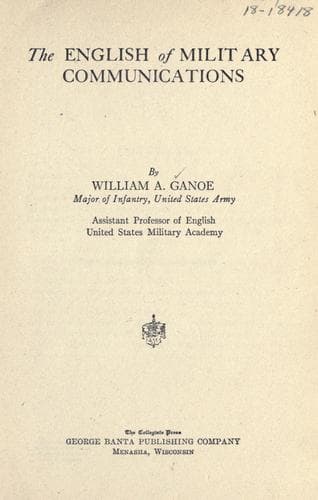
The English of military communicationsGanoe, William Addleman
History
The English of military communications
Ganoe, William Addleman
English language -- Rhetoric; Military orders; United States. Army -- Records and correspondence
4.—On May the 2d, 1919, at 4 a. m., you wish copies of this your 12th
field order since the beginning of the year sent to the commanders
of the first brigade, the artillery brigade, and the 10th cavalry by
Lieut. Alber; to the commanders of the second brigade, the engineer
battalion, the signal company, and the chief surgeon by Captain
Cutts; to the commander of the third brigade, and to Major Quincy by
Sgt. Donohue. Your name is Major General Slump. You are in command
of the second division of the third army corps. Your division is at
Platte City, Missouri. There are two divisions of the enemy who are
coming down against Platte City from the north. You know this to
be reliable information, and you know, also, that one division of
the enemy went into camp last night before you found out that the
outposts of that division were six miles north of Tracy on the road
that runs through Tracy and Severn. The other division, you know,
camped six miles further to the north. You give, in your order, the
direction that the first brigade is to take up a position on the
west end of the farm road which runs west from Nile. You want this
brigade to be prepared to make all sorts of resistance—in fact, you
want it to delay the enemy’s advance, and to hold this position
until you order it to retire further. You decide really that your
whole division should go into a position west of the Platte river.
Your idea is that it should hold back the enemy there, and should
hold it back sufficiently until the trains can be withdrawn. When
the trains are all withdrawn, then you ought to be able to make
an orderly retreat in the general direction of the Nile. At the
crack of dawn the next day, you figure that the cavalry ought to
begin going out and looking for the enemy with all possible speed
and vigilance. And then, too, you think that the cavalry ought to
look out especially for your left flank. Your second brigade should
start out at ten minutes to five the next morning. It should go to
“E” and should close up off the road near “E,” and should march by
the B-D road. This brigade is to be the second line and it should
take up such a position and be in such a state as to hold back any
movement of the enemy which should come in this direction. If it
is going to be necessary, this second brigade ought to cover the
troops of the first line who are withdrawing. The engineer battalion
should be ready to march out at half past four; it ought to follow
immediately behind the artillery brigade until the engineer battalion
gets somewhere beyond Tracy. The signal company will be ready to
march at twenty-five minutes of five and to follow the battalion of
engineers until the signal company gets to the southeast corner of
Tracy. The advance should move out in this way: the supply trains,
the ammunition columns, the bridge train, and the field hospital will
march at a quarter of four and they should march toward Leavenworth.
Public-domain text, read in full here on John Shaqi.
Reviews
Reviews
No reviews yet
Be the first to share your thoughts on this work.
Elsewhere in the archive
Join the Discussion
Join the discussion
Sign in to leave a comment or review.
Sign InorCreate an account