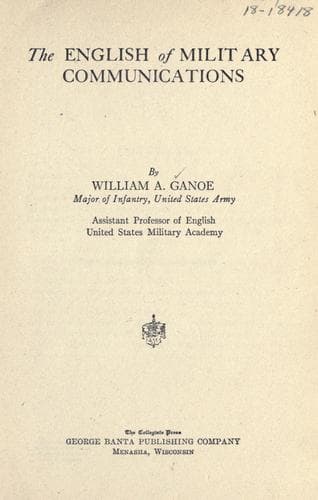
The English of military communicationsGanoe, William Addleman
History
The English of military communications
Ganoe, William Addleman
English language -- Rhetoric; Military orders; United States. Army -- Records and correspondence
take a position somewhere near the road fork of 617; this road fork
is just about a mile and a quarter south of the camp where you are.
Support No. 2 should cover the territory which is included in the
ground around the stream, which is west on the road for 617, to a
point 500 yards east of this road fork. The reserve should consist of
the first infantry, of which five companies will already have been
taken out, and also fourteen scouts. You want the wagons of the field
trains to go ahead right away and join the organizations to which
they ordinarily belong. Support No. 3 is to be under the command of
Captain Nutt, and is to consist of Company H and six mounted scouts.
Those wagons of the field trains, which belong to the companies in
support, will join the wagons of the regimental headquarters; they
will do this by eight o’clock in the evening. Support No. 3, under
the command of Captain Nelson, will consist of Company I, excepting
the first section, and two mounted orderlies. Support No. 2, under
the command of Major King, will consist of the second battalion,
all except Companies G and H and will also consist of four mounted
scouts. You want to tell your troops that your brigade to which
your regiment belongs is about to go into camp in the vicinity of
Bonnyville.
MARCH ORDERS WITH ADVANCE AND REAR GUARD
9.—On the 4th of September, 1956, you are Major Britton. You are
in command of the fourth division of the 19th army corps and you
are about to issue an order which will keep your division on the
march on the next morning; you have been marching. At 10 o’clock
at night you issue your order near Abbottstown, stating that you
yourself are going to be at the head of your main body. You feel
that you should march in the general direction of York on the next
day. Your main body in this order of march will consist of the first
infantry, of the second battalion of the 8th field artillery, of
the third brigade, of signal company “D,” and of the four ambulance
companies. Your main body should move out so as to come along behind
the advance guard, so that the tail of the advance guard will be
1,000 yards ahead of the head of the main body itself. Wagon trains
should move out so that they in turn will come along behind the main
body, so that the head of the lead horses will be 1,000 yards behind
the tail of the main body. You are in such a position between two
large forces of the enemy that you must have a rear guard. This rear
guard will be in command of Major General Huff. It will consist of
the first cavalry division, of the second brigade, of the 7th field
artillery, of the 4th battalion of engineers, and of the 1st, 2d,
and 3d ambulance companies. You hear that the enemy has probably been
reenforced and that this reenforcement probably consists of a brigade
of cavalry. You also hear, just when you issue this, your 7th field
order of the campaign, that there are some hostile infantrymen near
York, say, about a brigade.
Public-domain text, read in full here on John Shaqi.
Reviews
Reviews
No reviews yet
Be the first to share your thoughts on this work.
Elsewhere in the archive
Join the Discussion
Join the discussion
Sign in to leave a comment or review.
Sign InorCreate an account