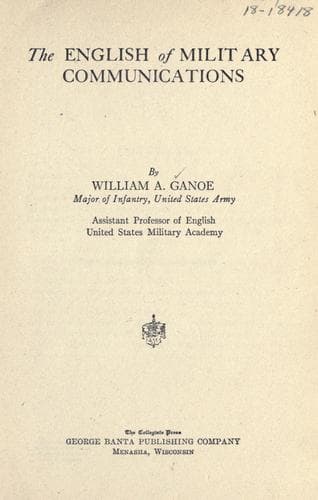
The English of military communicationsGanoe, William Addleman
History
The English of military communications
Ganoe, William Addleman
English language -- Rhetoric; Military orders; United States. Army -- Records and correspondence
7.—You are Captain Small in command of Troop A of the preceding
problem. You are to constitute, as you remember, the advance guard
of the squadron of independent cavalry. You wish to tell your
officers and non-commissioned officers, whom you have assembled, that
Lieutenant Butler and Sgt. Clifford are out with patrols, and you
want to give them the information you have got from your major in
regard to your own troops and the enemy. You want Corporal Dillingham
to take four men and to go ahead of the troop. He is to go at a rate
of about six miles per hour until Conewago Creek is crossed; after
that, he is to go about four miles an hour. When he gets about a mile
north of Gettysburg he is to take the right-hand road which goes
through Table Rock and Center Mills. He is to give quick and prompt
warning of the appearance of any of the enemy or hostile troops
which he encounters. He is also to report promptly any places in
the road which cannot be crossed by troops or vehicles. In fact, he
is to report any information which will interfere with the march of
the squadron. You, as the captain of the troop, are going to march
between the advance party and the support.
8.—You are Major Adams and you are in command of a squadron of
cavalry which is mounted and ready for action at D-6. You see a
squadron of the enemy in an open field to the west, about 600 yards
west of the woods where you are located. You see the guidons mounted,
and you see that the remainder of the men are leading their horses
into line or are saddling up. You note, also, through your glasses,
that the guidons are facing in your direction. You note, also,
that the wagons have left the camp and have gone around the woods
just north. You call your captains together and you issue a verbal
order—you have decided to attack the hostile squadron at once, and
to attack that squadron while you are mounted. You want Troops D and
C, commanded by Captain Denton, who is senior to Captain Clifford,
to form the main attacking line. You want Captain Denton to take
advantage of an opening in the woods which is about 150 yards to
your front. He is to attack the enemy in close order, mounted, as
soon as he has cleared the woods in which you are all located. You
give to the captains the information which you have got through your
field glasses. You also state that Captain Billings with his troop,
Troop B, is to go in rear of Troops D and C and form the supporting
line, keeping a distance of about 150 yards, and at the same time he
is to look out for the right flank. You want Lieutenant Fink, who
is the squadron adjutant, and who has seen the same things through
his glasses as you have seen, to accompany Captain Denton with his
two troops to the edge of the woods, where he is to point out to
Captain Denton the enemy’s position. You yourself are going to be
with the reserve. Captain Andrews with his troop, Troop A, is to
constitute the reserve. Captain Andrews with his command is to follow
Public-domain text, read in full here on John Shaqi.
Reviews
Reviews
No reviews yet
Be the first to share your thoughts on this work.
Elsewhere in the archive
Join the Discussion
Join the discussion
Sign in to leave a comment or review.
Sign InorCreate an account