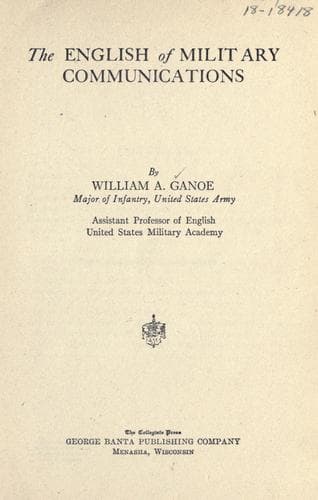
The English of military communicationsGanoe, William Addleman
History
The English of military communications
Ganoe, William Addleman
English language -- Rhetoric; Military orders; United States. Army -- Records and correspondence
They may take either one of two forms: either they may be dated,
headed “Report on so-and-so” (see example on following), and inclosed
with a letter of transmittal; or they may themselves be in the form
of letters addressed directly to the person or office for whom they
are destined.
Reports may consist of expository description on the one hand or of a
narration on the other, but they usually consist of a combination of
the two.
Here is an example of highly expository description. It is the report
upon the German raid which was given us under _Operation Orders_.
In the field, 12th April, 1916.
CAPTAIN WAGENER’S REPORT ON THE RAID ON THE EVENING OF 11TH APRIL,
1916
At 4 p. m. the raiding party marched from Martinpuich through
Pozières, then by the Lattorf Graben—Regimentstrichter—Krebs Graben
to the Appointed dug-outs on the left of Sap No. 3, where the
evening meal was found ready prepared.
At 8 p. m. the artillery preparation commenced as prearranged.
Shortly after fire was opened, the whole of the enemy’s position
from Windmühle to Besenhecke was wrapped in greyish-white smoke,
which the wind drove back over Sap No. 3 into our lines.
By 8.10 p. m. it was impossible to remain in our trench east of Sap
No. 3 without wearing a gas mask. This was still the case at 8.20
p. m., when the patrols moved forward from their dug-outs to the
Hohlweg, in the order Stradtmann, Dumas, Böhlefeld, and Freund.
Lieutenant Boenig followed close behind Lieutenant Stradtmann.
By 8.25 p. m. the party was posted ready in the Hohlweg. The clouds
of gas and smoke, however, still hung so thick over the enemy’s
trenches that it was impossible to distinguish whether our own
shells were still falling on the point of entry or whether our
artillery had already lengthened their range.
At 8.27 p. m. Lieutenant Stradtmann received the order to advance
to the attack with his patrol. Lieutenant Boenig, with the six
stretcher bearers, left the Hohlweg simultaneously and in rear of
Stradtmann’s patrol, and posted connecting files, whose positions
were marked by red signal lamps shaded to the front and to the
sides.
At 8.28 p. m. Dumas’ and Böhlefeld’s patrols advanced. Following
the line of connecting files, they reached the point of entry, to
find that Stradtmann’s patrol was already in possession of 16 yards
of trench, and had captured three prisoners. The latter had come
out of their dug-outs just as Lieutenant Stradtmann appeared in
front of the enemy’s trench. They carried hand grenades and rifles
with bayonets fixed, but were immediately disarmed by Lieutenants
Boenig and Stradtmann.
Public-domain text, read in full here on John Shaqi.
Reviews
Reviews
No reviews yet
Be the first to share your thoughts on this work.
Elsewhere in the archive
Join the Discussion
Join the discussion
Sign in to leave a comment or review.
Sign InorCreate an account