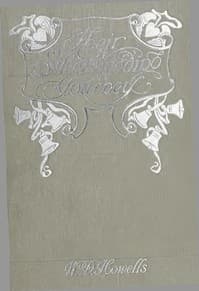
The Entire March Family TrilogyHowells, William Dean
General
The Entire March Family Trilogy
Howells, William Dean
Fiction; Literature -- Collections
Their house-hunting no longer had novelty, but it still had
interest; and they varied their day by taking a coupe, by renouncing
advertisements, and by reverting to agents. Some of these induced
them to consider the idea of furnished houses; and Mrs. March learned
tolerance for Fulkerson by accepting permits to visit flats and houses
which had none of the qualifications she desired in either, and were
as far beyond her means as they were out of the region to which she had
geographically restricted herself. They looked at three-thousand and
four-thousand dollar apartments, and rejected them for one reason or
another which had nothing to do with the rent; the higher the rent
was, the more critical they were of the slippery inlaid floors and the
arrangement of the richly decorated rooms. They never knew whether they
had deceived the janitor or not; as they came in a coupe, they hoped
they had.
They drove accidentally through one street that seemed gayer in the
perspective than an L road. The fire-escapes, with their light iron
balconies and ladders of iron, decorated the lofty house fronts; the
roadway and sidewalks and door-steps swarmed with children; women's
heads seemed to show at every window. In the basements, over which
flights of high stone steps led to the tenements, were green-grocers'
shops abounding in cabbages, and provision stores running chiefly to
bacon and sausages, and cobblers' and tinners' shops, and the like, in
proportion to the small needs of a poor neighborhood. Ash barrels lined
the sidewalks, and garbage heaps filled the gutters; teams of all trades
stood idly about; a peddler of cheap fruit urged his cart through the
street, and mixed his cry with the joyous screams and shouts of the
children and the scolding and gossiping voices of the women; the burly
blue bulk of a policeman defined itself at the corner; a drunkard
zigzagged down the sidewalk toward him. It was not the abode of the
extremest poverty, but of a poverty as hopeless as any in the world,
transmitting itself from generation to generation, and establishing
conditions of permanency to which human life adjusts itself as it does
to those of some incurable disease, like leprosy.
The time had been when the Marches would have taken a purely
aesthetic view of the facts as they glimpsed them in this street of
tenement-houses; when they would have contented themselves with saying
that it was as picturesque as a street in Naples or Florence, and with
wondering why nobody came to paint it; they would have thought they were
sufficiently serious about it in blaming the artists for their failure
to appreciate it, and going abroad for the picturesque when they had it
here under their noses. It was to the nose that the street made one of
its strongest appeals, and Mrs. March pulled up her window of the coupe.
“Why does he take us through such a disgusting street?” she demanded,
with an exasperation of which her husband divined the origin.
Public-domain text, read in full here on John Shaqi.
Reviews
Reviews
No reviews yet
Be the first to share your thoughts on this work.
Elsewhere in the archive
Join the Discussion
Join the discussion
Sign in to leave a comment or review.
Sign InorCreate an account