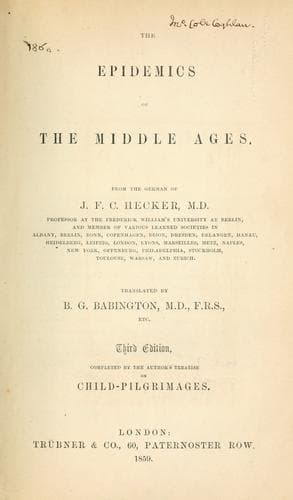
The Epidemics of the Middle AgesHecker, J. F. C. (Justus Friedrich Carl)
History
The Epidemics of the Middle Ages
Hecker, J. F. C. (Justus Friedrich Carl)
Black Death; Epidemics -- History; Hysteria, Epidemic
The cure effected by these stormy attacks was in many cases so perfect,
that some patients returned to the factory or the plough as if nothing
had happened. Others, on the contrary, paid the penalty of their folly
by so total a loss of power, that they could not regain their former
health, even by the employment of the most strengthening remedies.
Medical men were astonished to observe, that women in an advanced state
of pregnancy were capable of going through an attack of the disease,
without the slightest injury to their offspring, which they protected
merely by a bandage passed round the waist. Cases of this kind were not
unfrequent so late as Schenck’s time. That patients should be violently
affected by music, and their paroxysms brought on and increased by it,
is natural with such nervous disorders; where deeper impressions are
made through the ear, which is the most intellectual of all the organs,
than through any of the other senses. On this account the magistrates
hired musicians for the purpose of carrying the St. Vitus’s dancers so
much the quicker through the attacks, and directed, that athletic men
should be sent among them in order to complete the exhaustion, which
had been often observed to produce a good effect[240]. At the same
time there was a prohibition against wearing red garments, because,
at the sight of this colour, those affected became so furious, that
they flew at the persons who wore it, and were so bent upon doing
them an injury that they could with difficulty be restrained. They
frequently tore their own clothes whilst in the paroxysm, and were
guilty of other improprieties, so that the more opulent employed
confidential attendants to accompany them, and to take care that they
did no harm either to themselves or others. This extraordinary disease
was, however, so greatly mitigated in Schenck’s time, that the St.
Vitus’s dancers had long since ceased to stroll from town to town; and
that physician, like Paracelsus, makes no mention of the tympanitic
inflation of the bowels. Moreover, most of those affected, were only
annually visited by attacks; and the occasion of them was so manifestly
referrible to the prevailing notions of that period, that if the
unqualified belief in the supernatural agency of saints could have
been abolished, they would not have had any return of the complaint.
Throughout the whole of June, prior to the festival of St. John,
patients felt a disquietude and restlessness which they were unable
to overcome. They were dejected, timid, and anxious; wandered about
in an unsettled state, being tormented with twitching pains, which
seized them suddenly in different parts, and eagerly expected the eve
of St. John’s day, in the confident hope, that by dancing at the altars
of this saint, or of St. Vitus, (for in the Breisgau aid was equally
sought from both,) they would be freed from all their sufferings. This
hope was not disappointed; and they remained, for the rest of the year,
Public-domain text, read in full here on John Shaqi.
Reviews
Reviews
No reviews yet
Be the first to share your thoughts on this work.
Elsewhere in the archive
Join the Discussion
Join the discussion
Sign in to leave a comment or review.
Sign InorCreate an account