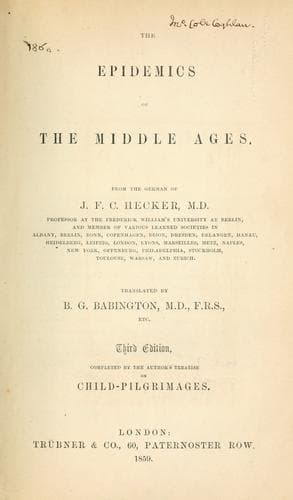
The Epidemics of the Middle AgesHecker, J. F. C. (Justus Friedrich Carl)
History
The Epidemics of the Middle Ages
Hecker, J. F. C. (Justus Friedrich Carl)
Black Death; Epidemics -- History; Hysteria, Epidemic
The dancing fit itself was excited here, as it probably was in other
places, by music, from the effects of which, the patients were thrown
into a state of convulsion[242]. Many concurrent testimonies serve to
show that music generally contributed much to the continuance of the
St. Vitus’s dance, originated, and increased its paroxysms, and was
sometimes the cause of their mitigation. So early as the fourteenth
century, the swarms of St. John’s dancers were accompanied by minstrels
playing upon noisy instruments, who roused their morbid feelings;
and it may readily be supposed that, by the performance of lively
melodies, and the stimulating effects which the shrill tones of fifes
and trumpets would produce, a paroxysm, that was perhaps but slight
in itself, might, in many cases, be increased to the most outrageous
fury, such as in later times, was purposely induced in order that
the force of the disease might be exhausted by the violence of its
attack. Moreover, by means of intoxicating music a kind of demoniacal
festival for the rude multitude was established, which had the effect
of spreading this unhappy malady wider and wider. Soft harmony was,
however, employed to calm the excitement of those affected, and it is
mentioned as a character of the tunes played with this view to the St.
Vitus’s dancers, that they contained transitions from a quick to a
slow measure, and passed gradually from a high to a low key[243]. It
is to be regretted that no trace of this music has reached our times,
which is owing partly to the disastrous events of the seventeenth
century, and partly to the circumstance that the disorder was looked
upon as entirely national, and only incidentally considered worthy
of notice by foreign men of learning. If the St. Vitus’s dance was
already on the decline at the commencement of the seventeenth century,
the subsequent events were altogether adverse to its continuance. Wars
carried on with animosity and with various success for thirty years,
shook the west of Europe; and although the unspeakable calamities which
they brought upon Germany, both during their continuance, and in their
immediate consequences, were by no means favourable to the advance of
knowledge, yet, with the vehemence of a purifying fire, they gradually
effected the intellectual regeneration of the Germans; superstition, in
her ancient form, never again appeared, and the belief in the dominion
of spirits, which prevailed in the middle ages, lost for ever its once
formidable power.
CHAPTER II.
DANCING MANIA IN ITALY.
SECT. 1.—TARANTISM.
Public-domain text, read in full here on John Shaqi.
Reviews
Reviews
No reviews yet
Be the first to share your thoughts on this work.
Elsewhere in the archive
Join the Discussion
Join the discussion
Sign in to leave a comment or review.
Sign InorCreate an account