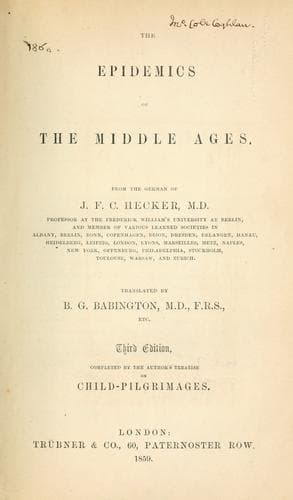
The Epidemics of the Middle AgesHecker, J. F. C. (Justus Friedrich Carl)
History
The Epidemics of the Middle Ages
Hecker, J. F. C. (Justus Friedrich Carl)
Black Death; Epidemics -- History; Hysteria, Epidemic
The persuasion of the inevitable consequences of being bitten by
the Tarantula, exercised a dominion over men’s minds which even the
healthiest and strongest could not shake off. So late as the middle
of the sixteenth century, the celebrated Fracastoro found the robust
bailiff of his landed estate groaning, and, with the aspect of a person
in the extremity of despair, suffering the very agonies of death,
from a sting in the neck, inflicted by an insect which was believed
to be a Tarantula. He kindly administered without delay, a potion of
vinegar and Armenian bole, the great remedy of those days for the
plague and all kinds of animal poisons, and the dying man was, as if by
a miracle, restored to life and the power of speech[299]. Now, since
it is quite out of the question that the bole could have any thing to
do with the result in this case, notwithstanding Fracastoro’s belief
in its virtues, we can only account for the cure by supposing, that a
confidence in so great a physician prevailed over this fatal disease
of the imagination, which would otherwise have yielded to scarcely any
other remedy except the Tarantella. Ferdinando was acquainted with
women who, for thirty years in succession, had overcome the attacks
of this disorder by a renewal of their annual dance—so long did they
maintain their belief in the yet undestroyed poison of the Tarantula’s
bite, and so long did that mental affection continue to exist, after it
had ceased to depend on any corporeal excitement[300].
Public-domain text, read in full here on John Shaqi.
Reviews
Reviews
No reviews yet
Be the first to share your thoughts on this work.
Elsewhere in the archive
Join the Discussion
Join the discussion
Sign in to leave a comment or review.
Sign InorCreate an account