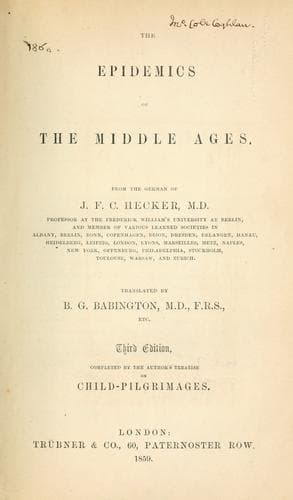
The Epidemics of the Middle AgesHecker, J. F. C. (Justus Friedrich Carl)
History
The Epidemics of the Middle Ages
Hecker, J. F. C. (Justus Friedrich Carl)
Black Death; Epidemics -- History; Hysteria, Epidemic
“February 26. Slight motions of the limbs came on in bed. She arose
at nine o’clock, after which they increased, and became unusually
severe. She was hurled from side to side of the couch-chair upon which
she sat, for a considerable time, without intermission; was sometimes
instantaneously and forcibly thrown upon her feet, when she jumped
and stamped violently. She had headache; the eyelids were frequently
affected, and she had often a sudden propensity to spring or leap
upwards. The affection ceased about eleven o’clock in the forenoon,
the patient being very much fatigued; but it returned about noon, and
a third time in the afternoon, when she was impelled into every corner
of the room, and began to strike the furniture and doors violently with
the hand, as she passed near them, the sound of which afforded her
great satisfaction. The fourth attack was at night; was very violent,
and ended with sickness and vomiting. She went to bed at half-past
eleven. Her nights were invariably good. The last three attacks were
more violent than the former ones, but they continued only half an hour
each.
“February 27. The attack commenced in bed, and was violent, but of
short duration. When she arose about ten, she had a second attack,
continuing an hour, except an interval of five minutes. She now struck
the furniture more violently and more repeatedly. Kneeling on one
knee, with the hands upon the back, she often sprang up suddenly and
struck the top of the room with the palm of the hand. To do this, she
rose fifteen inches from the floor, so that the family were under the
necessity of drawing all the nails and hooks from the ceiling. She
frequently danced upon one leg, holding the other with the hand, and
occasionally changing the legs. In the evening, the family observed
the blows upon the furniture to be more continuous, and to assume
the regular time and measure of a musical air. As a strain or series
of strokes was concluded, she ended with a more violent stroke or a
more violent spring or jump. Several of her friends also at this time
noticed the regular measure of the strokes, and the greater regularity
the disease was assuming; the motions being evidently affected, or in
some measure modified by the strokes upon the surrounding bodies. She
chiefly struck a small slender door, the top of a chest of drawers, the
clock, a table, or a wooden screen placed near the door. The affection
ceased about nine o’clock, when the patient went to bed.
Public-domain text, read in full here on John Shaqi.
Reviews
Reviews
No reviews yet
Be the first to share your thoughts on this work.
Elsewhere in the archive
Join the Discussion
Join the discussion
Sign in to leave a comment or review.
Sign InorCreate an account