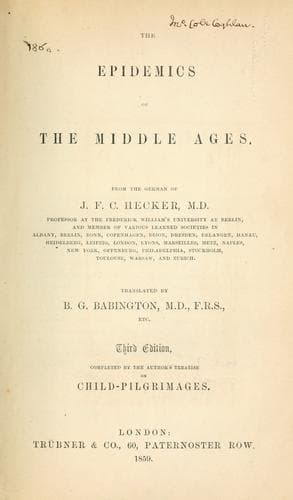
The Epidemics of the Middle AgesHecker, J. F. C. (Justus Friedrich Carl)
History
The Epidemics of the Middle Ages
Hecker, J. F. C. (Justus Friedrich Carl)
Black Death; Epidemics -- History; Hysteria, Epidemic
| husbandman that still hunted about graves, and kept in churchyards, |
| of a pale, black, ugly, and fearful look. Such, belike, or little |
| better, were king Prœtus’ daughters, (_Hippocrates_ lib. de |
| insaniâ,) that thought themselves kine: and Nebuchadnezzar, in |
| Daniel, as some interpreters hold, was only troubled with this |
| kind of madness. This disease, perhaps, gave occasion to that bold |
| assertion of Pliny, (Lib. 8. cap. 22. homines interdum lupos fieri; |
| et contra,) _some men were turned into wolves in his time, and from |
| wolves to men again_; and to that fable of Pausanias, of a man that |
| was ten years a wolf, and afterwards turned to his former shape; to |
| Ovid’s (Met. lib. 1.) tale of Lycaon, &c. He that is desirous to |
| hear of this disease, or more examples, let him read _Austin_ in |
| his eighteenth book, _de Civitate Dei_, cap. 5; _Mizaldus_, cent. |
| 5. 77; _Schenkius_, lib. 1. _Hildesheim, Spicil. 2. de maniâ_; |
| Forestus, lib. 10. _de morbis cerebri; Olaus Magnus; Vicentius |
| Bellavicensis, spec. met._ lib. 31. c. 122; _Pierius, Bodine, |
| Zuinger, Zeilgur, Peucer, Wierus, Spranger, &c._ This malady, saith |
| _Avicenna_, troubleth men most in February, and is now-a-days |
| frequent in Bohemia and Hungary, according to _Heurnius_. (Cap. de |
| Man.) _Schernitzius_ will have it common in Livonia. They lie hid, |
| most part, all day, and go abroad in the night, barking, howling, |
| at graves and deserts; _they have usually hollow eyes, scabbed legs |
| and thighs, very dry and pale_, (Ulcerata crura; sitis ipsis adest |
| immodica; pallidi; lingua sicca,) saith _Altomarus_: he gives a |
| reason there of all the symptoms, and sets down a brief cure of |
| them.”—_Burton’s Anatomy of Melancholy._ Tenth Edit.: 8vo. 1804. |
| Vol. 1. Page 13, et seq. |
| |
| It is surprising that so learned a writer as _Burton_ should |
| not have alluded to Oribasius, who flourished 140 years before |
| _Aëtius_, and of whom _Freind_ says, “In auctore hoc miri cujusdam |
| morbi prima mentio est; is Λυκάνθρωπος sive Λυκανθρωπία dicitur, |
| estque melancholiæ, aut insaniæ, species quænam ita ab illo |
| descripta: ‘Quos hoc malum infestos habet, nocturno tempore domo |
| egressi, Lupos in omnibus rebus imitantur, et ad diem usque circa |
| tumulos vagantur mortuorum. Hos ita cognosce: pallidi sunt, oculos |
| hebetes et siccos, non illachrymantes, eosque concavos habent: |
| lingua siccissima est, nulla penitus in ore saliva conspicitur, |
| siti enecti; crura vero, quia noctu sæpe offendunt, sine remedio |
| exulcerata.’—‘Quod ad morbum ipsum attinet, si peregrinantibus |
| fides adhibenda est, fuit olim in quibusdam regionibus, ut in |
Public-domain text, read in full here on John Shaqi.
Reviews
Reviews
No reviews yet
Be the first to share your thoughts on this work.
Elsewhere in the archive
Join the Discussion
Join the discussion
Sign in to leave a comment or review.
Sign InorCreate an account