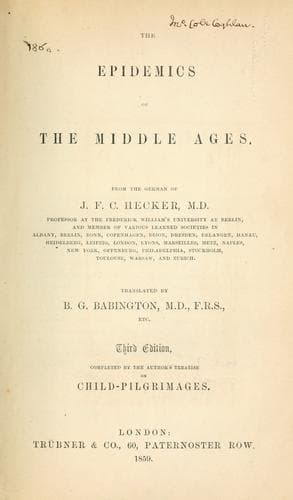
The Epidemics of the Middle AgesHecker, J. F. C. (Justus Friedrich Carl)
History
The Epidemics of the Middle Ages
Hecker, J. F. C. (Justus Friedrich Carl)
Black Death; Epidemics -- History; Hysteria, Epidemic
It is, however, also to be considered, on the other side, that the
French army was more exposed to the epidemic influence of the air, the
water, and the general powers of nature, than any other assemblage
of men, and, that this influence was probably more powerful in the
year 1529, than at any other time during the sixteenth century. The
formation of fog in the heat of summer is at all times an extraordinary
phenomenon[512], which decidedly indicates a disproportion in the
mutual action of the components and powers of the lower strata of the
atmosphere. This was not dependent merely on the local peculiarities
of Naples, for during the summer of 1528, grey fogs were observed
throughout Italy, which rendered the unwholesome quality of the air
visible to the eye[513]. This was increased by the prevalence of
southerly winds, which are always, in Italy, prejudicial to health,
as also by the thousand privations of a camp, so that a disease which
was already prevalent all over Italy,—we allude to the _petechial
fever_,—might well break out on the damp soil of Poggio reale. In the
history of national diseases, we find a moral proof of the predominance
of epidemic influence which plainly and intelligibly manifests itself
under the greatest variety of circumstances. This is a belief, that the
water, and even the air is poisoned[514]. Nor is this proof wanting
in the deplorable history of the French army before Naples, for it
was generally believed, that some Spaniards of Moorish descent, to
whom was attributed an especial degree of skill in the management of
poison, and some Jews from Germany, who, for the sake of gain, had
followed the lansquenets to truckle for their booty, had stolen out
of the city under cover of the night, in order to poison the water
in the neighbourhood of the camp[515]. It was also surmised, that
an Italian apothecary had administered to the French knights poison
in their medicine[516]. We will not anticipate on this occasion the
researches of naturalists, whose experiments on air and water, during
important epidemics, have not yet led to any results; it is, however,
not improbable that pond and spring water, under such circumstances as
are here described to have occurred, might become impregnated with a
noxious quality not inherent in it, which would very naturally give
rise to the belief that a poison had been thrown into it. On the whole,
this accusation may certainly be judged according to the same views
which have been stated in our treatise on the Black Death.
Public-domain text, read in full here on John Shaqi.
Reviews
Reviews
No reviews yet
Be the first to share your thoughts on this work.
Elsewhere in the archive
Join the Discussion
Join the discussion
Sign in to leave a comment or review.
Sign InorCreate an account