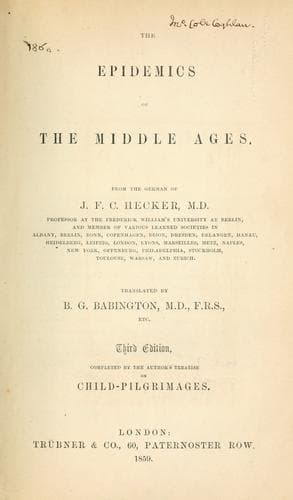
The Epidemics of the Middle AgesHecker, J. F. C. (Justus Friedrich Carl)
History
The Epidemics of the Middle Ages
Hecker, J. F. C. (Justus Friedrich Carl)
Black Death; Epidemics -- History; Hysteria, Epidemic
It is no less in point here to notice a kind of faint lassitude,
which, to the great astonishment of the people, was felt, especially
in Pomerania, in June and July[565], up to the very period when the
Sweating Sickness broke out. In the midst of their work, and without
any conceivable cause, people became palsied in their hands and
feet, so that even if their lives had depended upon it, they were
incapable of the slightest exertion[566]. The treatment which was found
successful, was to cover the patients warmly, and to supply them with
nourishing food, of which they ate plentifully, and thus recovered
again, in three or four days. Phenomena of this kind, which in the
present instance evidently depended on atmospherical influence, are but
the extreme gradations of a generally morbid dullness of vital feeling,
which might easily pass into an actual disgust of life, such as would
lead to suicide.
The following years were by no means all marked by a complete failure
in produce. The year 1530 was, on the contrary, plentiful, there being
only some partial failures, as, for example, that which arose from a
great flood in the district of the Saal, which occurred in the midst
of the harvest time[567]. A very cold spring and a wet cold summer
followed in 1531, with only occasional fine days; yet the ground
was not altogether unproductive, and the great distress which would
otherwise have been felt in Thuringia and Saxony, was checked by the
establishment of granaries, so that the people were not obliged, as
they often were in Swabia, to mow the green corn that they might dry
the ears in ovens, and support life upon the yet unripe grain.
The years 1532 and 1533, were again very sterile, as also 1534, in
consequence of the great heat and dryness of the summer. Finally,
in the year 1535, the regular change of the seasons, and with it
a prosperous state of cultivation, seemed to be restored, and the
scarcity ceased[568]. The reports from different localities in Germany
vary much, but the scarcity prevailed for full seven years[569], (from
1528 to 1534,) and since its causes were not discoverable, because it
was only seen by each observer in his own narrow circle, the old German
adage was often called to mind: “If there is to be a scarcity, it is of
no avail even should all the mountains be made of flour.”[570]
SECT. 5.—SWEATING SICKNESS IN GERMANY, 1529.
Public-domain text, read in full here on John Shaqi.
Reviews
Reviews
No reviews yet
Be the first to share your thoughts on this work.
Elsewhere in the archive
Join the Discussion
Join the discussion
Sign in to leave a comment or review.
Sign InorCreate an account