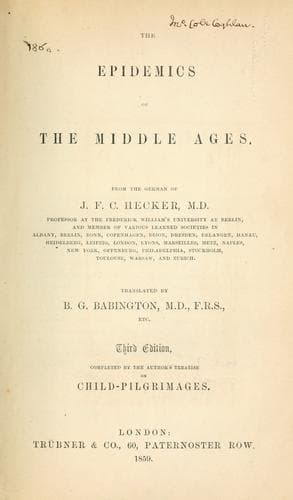
The Epidemics of the Middle AgesHecker, J. F. C. (Justus Friedrich Carl)
History
The Epidemics of the Middle Ages
Hecker, J. F. C. (Justus Friedrich Carl)
Black Death; Epidemics -- History; Hysteria, Epidemic
With respect, however, to the influence which the companions of
Hermann Evers, impregnated as they were with the odour of the Sweating
Sickness, had on the inhabitants of Hamburgh, it cannot be denied,
that their intercourse with those inhabitants, in the filthy and
narrow lanes of that commercial city, may have given an impulse to the
eruption of the pestilence, so far as to make the already existing fuel
more inflammable, or to furnish the first sparks for its ignition:
yet it is equally undeniable that, under the existing circumstances,
the epidemic Sweating Sickness would have broken out in Germany even
without the presence of Captain Evers, although it might, perhaps,
have been some weeks later, and not have made its first appearance in
Hamburgh, whose inhabitants, owing to the constant prevalence of the
North Sea fog, were, to all appearance, already prepared for the first
reception of this fatal disease.
To determine to a day when epidemics which have been long in
preparation have broken out, is, even for an observer who is present,
exceedingly difficult, nay, sometimes, under the most favourable
circumstances, impossible; for there occur in these visitations,
certain transitions into the epidemic form, of diseases which are
allied to it, as well as a gradual conversion into it of morbid
phenomena, which have usually begun some time before. Unless we are
greatly mistaken, such was the case in the pestilence of which we are
now treating; although it must be confessed, that we can obtain no
precise information on this point from the physicians of those times.
The following statements, for the absolute precision of which we cannot
pledge ourselves after a lapse of 300 years, must therefore be judged
according to this general experience; and though singly they may prove
little, yet taken altogether, they are capable of demonstrating the
peculiar and almost wonderful manner in which the Sweating Fever spread
over Germany.
In Lübeck, the next city in the Baltic, the Sweating Sickness appeared
about the same time; for so early as the Friday before St. Peter _in
vinculis_ (30th of July), it was known, that on the preceding night
a woman had died of it[578]. On the following days cases of death
fearfully increased, and the disorder soon raged so violently, that
people were again reminded of the Black Death of 1349. The inhabitants
died without number, as well in the city as in the environs, and the
consternation was equal to that felt in Hamburgh[579]. In general, as
was everywhere the case, robust young people of the better classes were
affected, while, on the other hand, children and poor people living in
cellars and garrets almost all of them escaped[580].
Public-domain text, read in full here on John Shaqi.
Reviews
Reviews
No reviews yet
Be the first to share your thoughts on this work.
Elsewhere in the archive
Join the Discussion
Join the discussion
Sign in to leave a comment or review.
Sign InorCreate an account