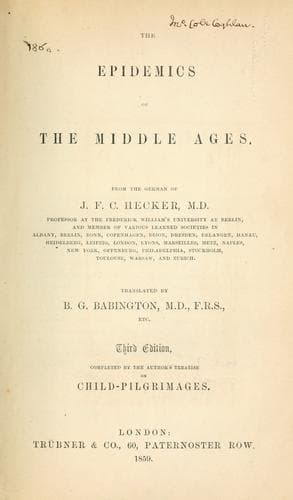
The Epidemics of the Middle AgesHecker, J. F. C. (Justus Friedrich Carl)
History
The Epidemics of the Middle Ages
Hecker, J. F. C. (Justus Friedrich Carl)
Black Death; Epidemics -- History; Hysteria, Epidemic
On the same day, namely, the 1st of September, the disease appeared
in Dantzig, fifty German miles further to the eastward, and was
here also so destructive, that it carried off in a short time 3000
inhabitants[587], some say even 6000—but this seems certainly too high
an estimate for Dantzig, and probably includes the greater part of
Prussia. If we were to give credence to an anonymous reporter[588],
this plague abated _in five days_, and relieved the inhabitants from
the mortal anxiety which, until they recovered their senses, led them
everywhere to commit acts of injustice and injury to avert the danger.
In Augsburg we find the Sweating Sickness on the 6th of September.
It lasted there also only _six days_, affected about 1500 of the
inhabitants, and destroyed more than half that number, or, as it is
said, about 800[589].
At Cologne it appeared precisely at the same time, as we learn from
the expressions of the Count von Newenar, a prelate of that place, who
finished his account of this disorder on the 7th of September[590]. At
Strasburg it broke out some ten or twelve days earlier, namely, on the
24th of August. In this place about 3000 people sickened in one week,
but very few of them died[591]. At Frankfort on the Maine they were
holding the autumn fair (which began on the 7th of September) just at
the time when the Sweating Sickness prevailed[592], whence arose the
opinion, which has been broached again in more modern times[593], that
the traders on their return carried the disease thence throughout the
whole of Germany, and that in the intercourse by means of this fair,
the main cause of the spread of the epidemic was to be found. After
the facts which have been brought forward, such a narrow view needs no
refutation. The Sweating Sickness was fleeter than the conveyances of
goods and people, which at that time made their way along the pathless
and unbeaten roads; for “no sooner did a rumour of the approach of the
disease reach anyplace than the disease itself accompanied it.”[594]
Public-domain text, read in full here on John Shaqi.
Reviews
Reviews
No reviews yet
Be the first to share your thoughts on this work.
Elsewhere in the archive
Join the Discussion
Join the discussion
Sign in to leave a comment or review.
Sign InorCreate an account