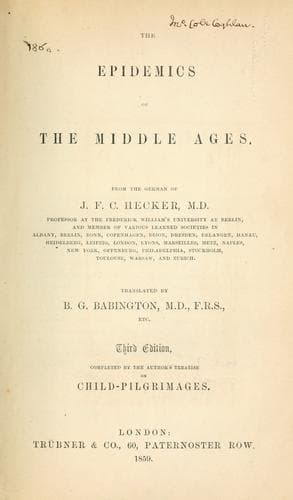
The Epidemics of the Middle AgesHecker, J. F. C. (Justus Friedrich Carl)
History
The Epidemics of the Middle Ages
Hecker, J. F. C. (Justus Friedrich Carl)
Black Death; Epidemics -- History; Hysteria, Epidemic
The persecution of the Jews commenced in September and October,
1348[138], at Chillon, on the Lake of Geneva, where the first criminal
proceedings were instituted against them, after they had long before
been accused by the people of poisoning the wells; similar scenes
followed in Bern and Freyburg, in January, 1349. Under the influence of
excruciating suffering, the tortured Jews confessed themselves guilty
of the crime imputed to them; and it being affirmed that poison had in
fact been found in a well at Zoffingen, this was deemed a sufficient
proof to convince the world; and the persecution of the abhorred
culprits, thus appeared justifiable. Now, though we can take as little
exception at these proceedings, as at the multifarious confessions of
witches, because the interrogatories of the fanatical and sanguinary
tribunals, were so complicated, that by means of the rack, the required
answer must inevitably be obtained; and it is besides conformable
to human nature, that crimes which are in every body’s mouth, may,
in the end, be actually committed by some, either from wantonness,
revenge, or desperate exasperation: yet crimes and accusations are,
under circumstances like these, merely the offspring of a revengeful,
frenzied spirit in the people; and the accusers, according to the
fundamental principles of morality, which are the same in every age,
are the more guilty transgressors.
Already in the autumn of 1348, a dreadful panic, caused by this
supposed empoisonment, seized all nations; in Germany especially, the
springs and wells were built over, that nobody might drink of them, or
employ their contents for culinary purposes: and for a long time, the
inhabitants of numerous towns and villages, used only river and rain
water[139]. The city gates were also guarded with the greatest caution:
only confidential persons were admitted; and if medicine, or any other
article, which might be supposed to be poisonous, was found in the
possession of a stranger,—and it was natural that some should have
these things by them for their private use,—they were forced to swallow
a portion of it[140]. By this trying state of privation, distrust and
suspicion, the hatred against the supposed poisoners became greatly
increased, and often broke out in popular commotions, which only served
still further to infuriate the wildest passions. The noble and the
mean, fearlessly bound themselves by an oath, to extirpate the Jews
by fire and sword, and to snatch them from their protectors, of whom
the number was so small, that throughout all Germany, but few places
can be mentioned where these unfortunate people were not regarded as
outlaws and martyred and burnt[141]. Solemn summonses were issued from
Bern to the towns of Basle, Freyburg in the Breisgau, and Strasburg, to
pursue the Jews as poisoners. The Burgomasters and Senators, indeed,
opposed this requisition; but in Basle the populace obliged them to
Public-domain text, read in full here on John Shaqi.
Reviews
Reviews
No reviews yet
Be the first to share your thoughts on this work.
Join the Discussion
Join the discussion
Sign in to leave a comment or review.
Sign InorCreate an account