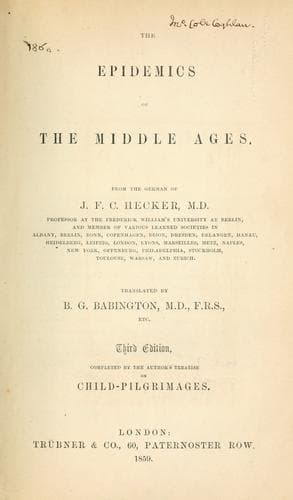
The Epidemics of the Middle AgesHecker, J. F. C. (Justus Friedrich Carl)
History
The Epidemics of the Middle Ages
Hecker, J. F. C. (Justus Friedrich Carl)
Black Death; Epidemics -- History; Hysteria, Epidemic
The humanity and prudence of Clement VI., must, on this occasion,
also be mentioned to his honour; but even the highest ecclesiastical
power was insufficient to restrain the unbridled fury of the people.
He not only protected the Jews at Avignon, as far as lay in his power,
but also issued two bulls, in which he declared them innocent; and
admonished all Christians, though without success, to cease from
such groundless persecutions[150]. The Emperor Charles IV. was also
favourable to them, and sought to avert their destruction, wherever
he could; but he dared not draw the sword of justice, and even found
himself obliged to yield to the selfishness of the Bohemian nobles,
who were unwilling to forego so favourable an opportunity of releasing
themselves from their Jewish creditors, under favour of an imperial
mandate[151]. Duke Albert of Austria burned and pillaged those of his
cities, which had persecuted the Jews,—a vain and inhuman proceeding,
which, moreover, is not exempt from the suspicion of covetousness; yet
he was unable, in his own fortress of Kyberg, to protect some hundreds
of Jews, who had been received there, from being barbarously burnt by
the inhabitants[152]. Several other princes and counts, among whom
was Ruprecht von der Pfalz, took the Jews under their protection on
the payment of large sums: in consequence of which they were called
“Jew-masters,” and were in danger of being attacked by the populace
and by their powerful neighbours[153]. These persecuted and ill-used
people, except indeed where humane individuals took compassion on them
at their own peril, or when they could command riches to purchase
protection, had no place of refuge left but the distant country
of Lithuania, where Boleslav V., Duke of Poland (1227–1279), had
before granted them liberty of conscience; and King Casimir the Great
(1333–1370), yielding to the entreaties of Esther, a favourite Jewess,
received them, and granted them further protection[154]: on which
account, that country is still inhabited by a great number of Jews,
who by their secluded habits, have, more than any people in Europe,
retained the manners of the middle ages.
Public-domain text, read in full here on John Shaqi.
Reviews
Reviews
No reviews yet
Be the first to share your thoughts on this work.
Join the Discussion
Join the discussion
Sign in to leave a comment or review.
Sign InorCreate an account