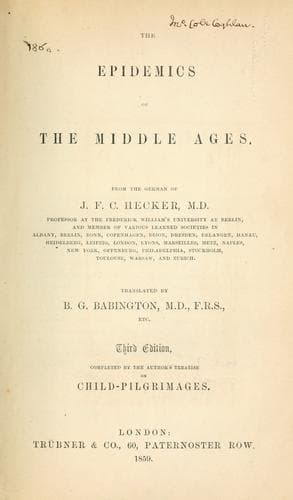
The Epidemics of the Middle AgesHecker, J. F. C. (Justus Friedrich Carl)
History
The Epidemics of the Middle Ages
Hecker, J. F. C. (Justus Friedrich Carl)
Black Death; Epidemics -- History; Hysteria, Epidemic
But to return to the fearful accusations against the Jews; it was
reported in all Europe, that they were in connexion with secret
superiors in Toledo, to whose decrees they were subject, and from
whom they had received commands respecting the coining of base money,
poisoning, the murder of Christian children, &c.[155]; that they
received the poison by sea from remote parts, and also prepared it
themselves from spiders, owls and other venomous animals; but, in
order that their secret might not be discovered, that it was known
only to the Rabbis and rich men[156]. Apparently there were but few
who did not consider this extravagant accusation well founded; indeed,
in many writings of the 14th century, we find great acrimony with
regard to the suspected poison mixers, which plainly demonstrates the
prejudice existing against them. Unhappily, after the confessions of
the first victims in Switzerland, the rack extorted similar ones in
various places. Some even acknowledged having received poisonous powder
in bags, and injunctions from Toledo, by secret messengers. Bags of
this description were also often found in wells, though it was not
unfrequently discovered that the Christians themselves had thrown them
in; probably to give occasion to murder and pillage; similar instances
of which may be found in the persecutions of the witches[157].
This picture needs no additions. A lively image of the Black Plague,
and of the moral evil which followed in its train, will vividly
represent itself to him who is acquainted with nature and the
constitution of society. Almost the only credible accounts of the
manner of living, and of the ruin which occurred in private life,
during this pestilence, are from Italy; and these may enable us to form
a just estimate of the general state of families in Europe, taking into
consideration what is peculiar in the manners of each country.
“When the evil had become universal,” (speaking of Florence,) “the
hearts of all the inhabitants were closed to feelings of humanity.
They fled from the sick and all that belonged to them, hoping by these
means to save themselves. Others shut themselves up in their houses,
with their wives, their children and households, living on the most
costly food, but carefully avoiding all excess. None were allowed
access to them; no intelligence of death or sickness was permitted
to reach their ears; and they spent their time in singing and music,
and other pastimes. Others, on the contrary, considered eating and
drinking to excess, amusements of all descriptions, the indulgence of
every gratification, and an indifference to what was passing around
them, as the best medicine, and acted accordingly. They wandered day
and night, from one tavern to another, and feasted without moderation
or bounds. In this way they endeavoured to avoid all contact with the
sick, and abandoned their houses and property to chance, like men whose
death-knell had already tolled.
Public-domain text, read in full here on John Shaqi.
Reviews
Reviews
No reviews yet
Be the first to share your thoughts on this work.
Join the Discussion
Join the discussion
Sign in to leave a comment or review.
Sign InorCreate an account