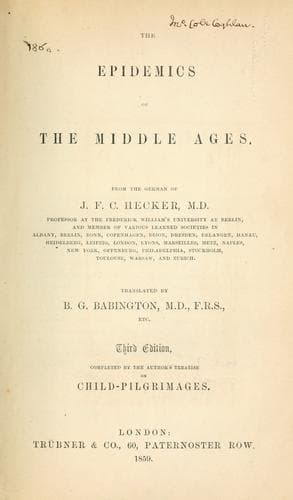
The Epidemics of the Middle AgesHecker, J. F. C. (Justus Friedrich Carl)
History
The Epidemics of the Middle Ages
Hecker, J. F. C. (Justus Friedrich Carl)
Black Death; Epidemics -- History; Hysteria, Epidemic
Arrangements for the protection of the healthy against contagious
diseases, the necessity of which is shewn from these notions, were
regarded by the ancients as useful; and by many, whose circumstances
permitted it, were carried into effect in their houses. Even a total
separation of the sick from the healthy, that indispensable means of
protection against infection by contact, was proposed by physicians
of the 2nd century after Christ, in order to check the spreading of
leprosy. But it was decidedly opposed, because, as it was alleged,
the healing art ought not to be guilty of such harshness[167]. This
mildness of the ancients, in whose manner of thinking inhumanity was
so often and so undisguisedly conspicuous, might excite surprise, if
it were any thing more than apparent. The true ground of the neglect
of public protection against pestilential diseases, lay in the general
notion and constitution of human society,—it lay in the disregard of
human life, of which the great nations of antiquity have given proofs
in every page of their history. Let it not be supposed that they wanted
knowledge respecting the propagation of contagious diseases. On the
contrary, they were as well informed on this subject as the moderns;
but this was shewn where individual property, not where human life, on
the grand scale, was to be protected. Hence the ancients made a general
practice of arresting the progress of murrains among cattle, by a
separation of the diseased from the healthy. Their herds alone enjoyed
that protection which they held it impracticable to extend to human
society, because they had no wish to do so[168]. That the governments
in the 14th century, were not yet so far advanced, as to put into
practice general regulations for checking the plague, needs no especial
proof. Physicians could, therefore, only advise public purifications of
the air by means of large fires, as had often been practised in ancient
times; and they were obliged to leave it to individual families,
either to seek safety in flight, or to shut themselves up in their
dwellings[169], a method which answers in common plagues, but which
here afforded no complete security, because such was the fury of the
disease when it was at its height, that the atmosphere of whole cities
was penetrated by the infection.
Public-domain text, read in full here on John Shaqi.
Reviews
Reviews
No reviews yet
Be the first to share your thoughts on this work.
Elsewhere in the archive
Join the Discussion
Join the discussion
Sign in to leave a comment or review.
Sign InorCreate an account