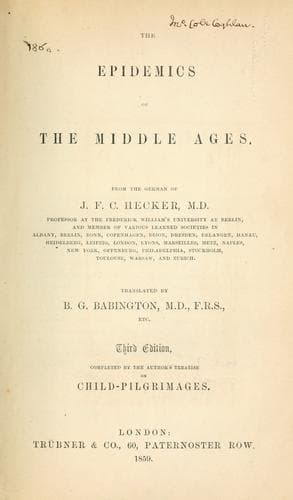
The Epidemics of the Middle AgesHecker, J. F. C. (Justus Friedrich Carl)
History
The Epidemics of the Middle Ages
Hecker, J. F. C. (Justus Friedrich Carl)
Black Death; Epidemics -- History; Hysteria, Epidemic
Balavignus further confessed that, after
having put the poison into the spring at Thonon, he had positively
forbidden his wife and children to drink the water, but had not thought
fit to assign a reason. He avowed the truth of this statement, and, in
the presence of several credible witnesses, swore by his law, and the
Five Books of Moses, to every item of his deposition.
On the day following, Balavignus, voluntarily and without torture,
ratified the above confession verbatim before many persons of
character, and, of his own accord, acknowledged that, on returning one
day from Tour near Vivey, he had thrown into a well below Mustruez,
namely that of La Conerayde, a quantity of the poison tied up in a rag,
given to him for the purpose by Aquetus of Montreantz, an inhabitant of
the said Tour: that he had acquainted Manssiono, and his son Delosaz,
residents of Neustadt, with the circumstance of his having done so, and
advertised them not to drink of the water. He described the colour of
the poison as being red and black.
On the nineteenth day of September, the above-named Balavignus
confessed, without torture, that about three weeks after Whitsuntide,
a Jew named Mussus told him that he had thrown poison into the well,
in the custom-house of that place, the property of the Borneller
family; and that he no longer drank the water of this well, but that
of the lake. He further deposed that Mussus informed him that he had
also laid some of the poison under the stones in the custom-house at
Chillon. Search was accordingly made in this well, and the poison
found: some of it was given to a Jew by way of trial, and he died
in consequence. He also stated that the rabbis had ordered him and
other Jews to refrain from drinking of the water for nine days after
the poison was infused into it; and immediately on having poisoned
the waters, he communicated the circumstance to the other Jews. He,
Balavignus, confessed that about two months previously, being at Evian,
he had some conversation on the subject with a Jew called Jacob, and,
among other things, asked him whether he also had received writings
and poison, and was answered in the affirmative; he then questioned
him whether he had obeyed the command, and Jacob replied that he had
not, but had given the poison to Savetus, a Jew, who had thrown it
into the Well de Morer at Evian. Jacob also desired him, Balavignus,
to execute the command imposed on him with due caution. He confessed
that Aquetus of Montreantz had informed him that he had thrown some of
the poison into the well above Tour, the water of which he sometimes
drank. He confessed that Samolet had told him that he had laid the
poison which he had received, in a well, which, however, he refused to
name to him. Balavignus, as a physician, further deposed that a person
infected by such poison coming in contact with another while in a state
of perspiration, infection would be the almost inevitable result; as
Public-domain text, read in full here on John Shaqi.
Reviews
Reviews
No reviews yet
Be the first to share your thoughts on this work.
Elsewhere in the archive
Join the Discussion
Join the discussion
Sign in to leave a comment or review.
Sign InorCreate an account