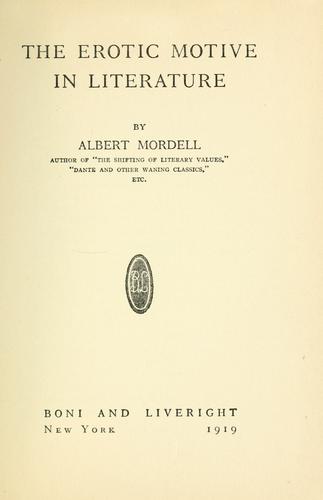
Erotic literature -- History and criticism; Psychoanalysis and literature; Sex in literature
Recall the allegories with which mediæval literature abounded. Even
the great short stories of Hawthorne, who was much influenced by Bunyan
and Spenser, show traces of mediæval forms. Literary tradition is
certainly stronger than originality. And the thousands of authors of
our day who write novels and short stories, would in mediæval times
have written allegories.
The ideas and mode of expression change, and hence makes much of the
old literature obsolete. But many emotions remain eternal. We can still
feel with Sappho and the Troubadours, whereas we find our intellect
insulted by some of the religious ideas versified by Dante and Milton;
although the passages describing secular emotions win our admiration.
When we must look for an author's unconscious buried in the literary
trappings of his day we weary of the task and dismiss his work. Why can
we not read the thousands of pastorals and allegories of the mediæval
writers? Is it not largely because of the feeble intellects, and spirit
of imitation present, because of the absence of the personal note?
The unconscious is buried too deeply in rigmarole. The works have a
psychological and historical but not artistic value. The religious
and romantic instincts in many of us are buried too deeply in our
unconscious, and hence we do not sympathise with those works.
Those poets live who have been most personal. The Roman poets, Horace,
Catullus, Titullus, Propertius, Ovid, Lucretius, were personal. Even
the _Æneid_ reveals the soul of Virgil in the story of Æneas and Dido.
The unconscious is present in all literature, and the literary movement
but colours it and gives occasion for the expression or censorship of
certain phases of it. Puritan writers are not in their unconscious any
different from the "immoral" ones; only the latter relax the censor and
give full play to the unconscious, when a liberal age like that of the
Restoration or the Renaissance, permits it.
Hence, though all writers draw on their unconscious and base their work
on their personal repressions, authors of one age differ in manner
and substance from those of another, not because the unconscious is
different (which it is not), but because it is fashionable to express
only certain features of it in one age; because writers have an
instinctive tendency to comply with the literary fashions of their
age; because the time spirit colours and censors those elements of the
unconscious which appear in the literary product.
IV
Public-domain text, read in full here on John Shaqi.
Reviews
Reviews
No reviews yet
Be the first to share your thoughts on this work.
Elsewhere in the archive
Join the Discussion
Join the discussion
Sign in to leave a comment or review.
Sign InorCreate an account