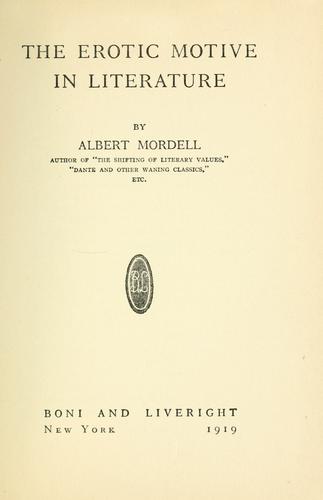
Erotic literature -- History and criticism; Psychoanalysis and literature; Sex in literature
We now come to two of his greatest odes, _To the Wild West Wind_ and
_To the Skylark_. Here, as in the case of Keats's two great odes, the
critics have feared to trace the poems to a love repression on the part
of the poet. In fact, most criticisms of the poems treat them as alien
to the subject of love. And yet unconsciously Shelley is here voicing
his longing for love and giving vent to his unconscious polygamous
instinct. Mr. Gribble, in his _Romantic Life of Shelley_, surmises that
the poet is really unconsciously expressing dissatisfaction with his
married life. When Shelley wrote these poems he was still groping for
love; he lived with his second wife, and as far as we know had no love
affair. He had not yet fallen in love with either Miss Viviani or Mrs.
Williams.
The _Ode to the West Wind_ was written in the fall of 1819. The poet
at the time was unhappy; a child of his had died, and his wife was
suffering great depression. When the poet was complaining that he
was falling on the thorns of life and bleeding, and speaking of the
"autumnal tone" in his life, he was referring to the repression of
his love life. He lived with Mary whom he did not love passionately.
If he concludes his poem with the prayer that the wind drive his dead
thoughts over the universe to quicken a new birth, he wants to profit
by this in love. He unconsciously meant that if his ideas on free love
should prevail, he would be able to take a new love without reproach
and without suffering such misfortunes as he did when he deserted his
first wife. He had been deprived of his children and was driven to
exile from his native land a year and a half previously, March, 1818.
It has been one of the ironies of Shelley's fate that the world has
admired this West Wind ode greatly, and tabooed the most important idea
Shelley wanted spread, that of free love. So if we read between the
lines in this great ode pleading for the dissemination of his idea,
we find the poet's unconscious stating he is unhappy and is longing
for another love than that of his wife. He pleads for a satisfaction
of his polygamous instincts. Should the reader think this conclusion
untenable, I can reply that the facts we have of the poet's life give
it unqualified support. Let us also remember that the fructifying wind
was always a sex symbol.
Public-domain text, read in full here on John Shaqi.
Reviews
Reviews
No reviews yet
Be the first to share your thoughts on this work.
Elsewhere in the archive
Join the Discussion
Join the discussion
Sign in to leave a comment or review.
Sign InorCreate an account