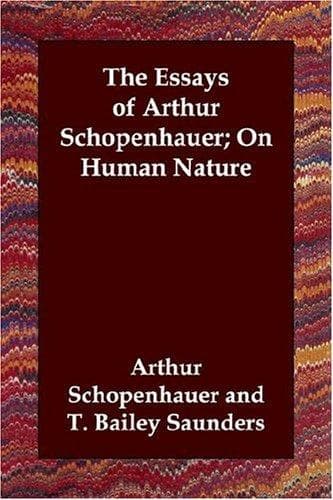
The Essays of Arthur Schopenhauer; On Human NatureSchopenhauer, Arthur
Philosophy
The Essays of Arthur Schopenhauer; On Human Nature
Schopenhauer, Arthur
Ethics; Political science
Just as civic honour--in other words, the opinion that we deserve to
be trusted--is the palladium of those whose endeavour it is to make
their way in the world on the path of honourable business, so knightly
honour--in other words, the opinion that we are men to be feared--is
the palladium of those who aim at going through life on the path
of violence; and so it was that knightly honour arose among the
robber-knights and other knights of the Middle Ages.
* * * * *
A theoretical philosopher is one who can supply in the shape of ideas
for the reason, a copy of the presentations of experience; just as
what the painter sees he can reproduce on canvas; the sculptor, in
marble; the poet, in pictures for the imagination, though they are
pictures which he supplies only in sowing the ideas from which they
sprang.
A so-called practical philosopher, on the other hand, is one who,
contrarily, deduces his action from ideas. The theoretical philosopher
transforms life into ideas. The practical philosopher transforms ideas
into life; he acts, therefore, in a thoroughly reasonable manner; he
is consistent, regular, deliberate; he is never hasty or passionate;
he never allows himself to be influenced by the impression of the
moment.
And indeed, when we find ourselves among those full presentations of
experience, or real objects, to which the body belongs--since the body
is only an objectified will, the shape which the will assumes in the
material world--it is difficult to let our bodies be guided, not by
those presentations, but by a mere image of them, by cold, colourless
ideas, which are related to experience as the shadow of Orcus to life;
and yet this is the only way in which we can avoid doing things of
which we may have to repent.
The theoretical philosopher enriches the domain of reason by adding to
it; the practical philosopher draws upon it, and makes it serve him.
* * * * *
According to Kant the truth of experience is only a hypothetical
truth. If the suppositions which underlie all the intimations of
experience--subject, object, time, space and causality--were removed,
none of those intimations would contain a word of truth. In other
words, experience is only a phenomenon; it is not knowledge of the
thing-in-itself.
If we find something in our own conduct at which we are secretly
pleased, although we cannot reconcile it with experience, seeing that
if we were to follow the guidance of experience we should have to
do precisely the opposite, we must not allow this to put us out;
otherwise we should be ascribing an authority to experience which
it does not deserve, for all that it teaches rests upon a mere
supposition. This is the general tendency of the Kantian Ethics.
* * * * *
Public-domain text, read in full here on John Shaqi.
Reviews
Reviews
No reviews yet
Be the first to share your thoughts on this work.
Elsewhere in the archive
Join the Discussion
Join the discussion
Sign in to leave a comment or review.
Sign InorCreate an account