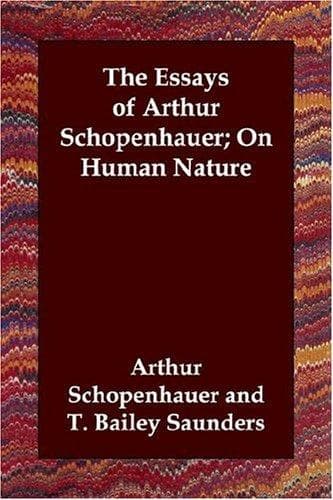
The Essays of Arthur Schopenhauer; On Human NatureSchopenhauer, Arthur
Philosophy
The Essays of Arthur Schopenhauer; On Human Nature
Schopenhauer, Arthur
Ethics; Political science
In one of them, this misery is immediately present to us. We feel it
in our own person, in our own will which, imbued with violent desires,
is everywhere broken, and this is the process which constitutes
suffering. The result is that the will increases in violence, as
is shown in all cases of passion and emotion; and this increasing
violence comes to a stop only when the will turns and gives way to
complete resignation, in other words, is redeemed. The man who is
entirely dominated by this mood will regard any prosperity which he
may see in others with envy, and any suffering with no sympathy.
In the opposite mood human misery is present to us only as a fact
of knowledge, that is to say, indirectly. We are mainly engaged in
looking at the sufferings of others, and our attention is withdrawn
from our own. It is in their person that we become aware of human
misery; we are filled with sympathy; and the result of this mood is
general benevolence, philanthropy. All envy vanishes, and instead
of feeling it, we are rejoiced when we see one of our tormented
fellow-creatures experience any pleasure or relief.
After the same fashion we may be in one of two opposite moods in
regard to human baseness and depravity. In the one we perceive this
baseness indirectly, in others. Out of this mood arise indignation,
hatred, and contempt of mankind. In the other we perceive it directly,
in ourselves. Out of it there arises humiliation, nay, contrition.
In order to judge the moral value of a man, it is very important to
observe which of these four moods predominate in him. They go in
pairs, one out of each division. In very excellent characters the
second mood of each division will predominate.
* * * * *
The categorical imperative, or absolute command, is a contradiction.
Every command is conditional. What is unconditional and necessary is a
_must_, such as is presented by the laws of nature.
It is quite true that the moral law is entirely conditional. There
is a world and a view of life in which it has neither validity nor
significance. That world is, properly speaking, the real world in
which, as individuals, we live; for every regard paid to morality is a
denial of that world and of our individual life in it. It is a view
of the world, however, which does not go beyond the principle of
sufficient reason; and the opposite view proceeds by the intuition of
Ideas.
* * * * *
Public-domain text, read in full here on John Shaqi.
Reviews
Reviews
No reviews yet
Be the first to share your thoughts on this work.
Elsewhere in the archive
Join the Discussion
Join the discussion
Sign in to leave a comment or review.
Sign InorCreate an account