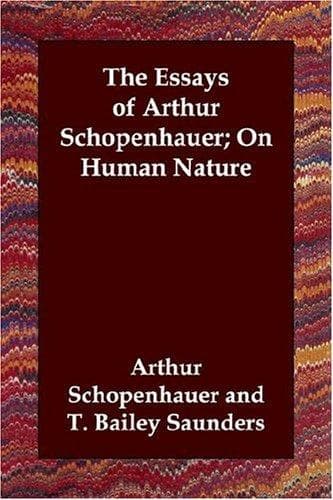
The Essays of Arthur Schopenhauer; On Human NatureSchopenhauer, Arthur
Philosophy
The Essays of Arthur Schopenhauer; On Human Nature
Schopenhauer, Arthur
Ethics; Political science
A lie always has its origin in the desire to extend the dominion of
one's own will over other individuals, and to deny their will in order
the better to affirm one's own. Consequently a lie is in its very
nature the product of injustice, malevolence and villainy. That is why
truth, sincerity, candour and rectitude are at once recognised and
valued as praiseworthy and noble qualities; because we presume that
the man who exhibits them entertains no sentiments of injustice or
malice, and therefore stands in no need of concealing such sentiments.
He who is open cherishes nothing that is bad.
* * * * *
There is a certain kind of courage which springs from the same source
as good-nature. What I mean is that the good-natured man is almost as
clearly conscious that he exists in other individuals as in himself. I
have often shown how this feeling gives rise to good-nature. It
also gives rise to courage, for the simple reason that the man who
possesses this feeling cares less for his own individual existence,
as he lives almost as much in the general existence of all creatures.
Accordingly he is little concerned for his own life and its
belongings. This is by no means the sole source of courage for it is
a phenomenon due to various causes. But it is the noblest kind of
courage, as is shown by the fact that in its origin it is associated
with great gentleness and patience. Men of this kind are usually
irresistible to women.
* * * * *
All general rules and precepts fail, because they proceed from the
false assumption that men are constituted wholly, or almost wholly,
alike; an assumption which the philosophy of Helvetius expressly
makes. Whereas the truth is that the original difference between
individuals in intellect and morality is immeasurable.
* * * * *
The question as to whether morality is something real is the question
whether a well-grounded counter-principle to egoism actually exists.
As egoism restricts concern for welfare to a single individual,
_viz_., the man's own self, the counter-principle would have to extend
it to all other individuals.
* * * * *
It is only because the will is above and beyond time that the stings
of conscience are ineradicable, and do not, like other pains,
gradually wear away. No! an evil deed weighs on the conscience years
afterwards as heavily as if it had been freshly committed.
* * * * *
Character is innate, and conduct is merely its manifestation; the
occasion for great misdeeds comes seldom; strong counter-motives keep
us back; our disposition is revealed to ourselves by our desires,
thoughts, emotions, when it remains unknown to others. Reflecting on
all this, we might suppose it possible for a man to possess, in some
sort, an innate evil conscience, without ever having done anything
very bad.
* * * * *
Public-domain text, read in full here on John Shaqi.
Reviews
Reviews
No reviews yet
Be the first to share your thoughts on this work.
Elsewhere in the archive
Join the Discussion
Join the discussion
Sign in to leave a comment or review.
Sign InorCreate an account