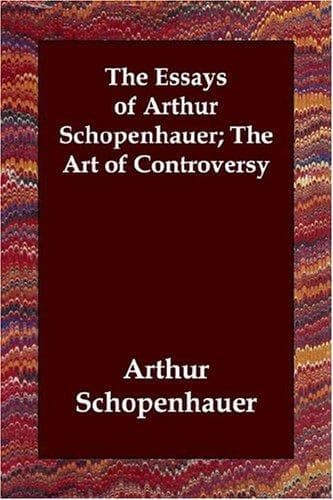
The Essays of Arthur Schopenhauer; the Art of ControversySchopenhauer, Arthur
Philosophy
The Essays of Arthur Schopenhauer; the Art of Controversy
Schopenhauer, Arthur
Debates and debating; Logic
In the hierarchy of physical organisation, strength of will is
attended by a corresponding growth in the intelligent faculties. A
high degree of knowledge, such as exists in the genius, presupposes a
powerful will, though, at the same time, a will that is subordinate
to the intellect. In other words, both the intellect and the will
are strong, but the intellect is the stronger of the two. Unless, as
happens in the case of the saint, the intellect is at once applied to
the will, or, as in the case of the artist, it finds its pleasures in
a reproduction of itself, the will remains untamed. Any strength that
it may lose is due to the predominance of pure objective intelligence
which is concerned with the contemplation of ideas, and is not, as
in the case of the common or the bad man, wholly occupied with the
objects of the will. In the interval, when the genius is no longer
engaged in the contemplation of ideas, and his intelligence is again
applied to the will and its objects, the will is re-awakened in all
its strength. Thus it is that men of genius often have very violent
desires, and are addicted to sensual pleasure and to anger. Great
crimes, however, they do not commit; because, when the opportunity of
them offers, they recognise their idea, and see it very vividly and
clearly. Their intelligence is thus directed to the idea, and so gains
the predominance over the will, and turns its course, as with the
saint; and the crime is uncommitted.
The genius, then, always participates to some degree in the
characteristics of the saint, as he is a man of the same
qualification; and, contrarily, the saint always participates to some
degree in the characteristics of the genius.
The good-natured character, which is common, is to be distinguished
from the saintly by the fact that it consists in a weakness of will,
with a somewhat less marked weakness of intellect. A lower degree of
the knowledge of the world as revealed in ideas here suffices to check
and control a will that is weak in itself. Genius and sanctity are
far removed from good-nature, which is essentially weak in all its
manifestations.
Apart from all that I have said, so much at least is clear. What
appears under the forms of time, space, and casuality, and vanishes
again, and in reality is nothing, and reveals its nothingness by
death--this vicious and fatal appearance is the will. But what does
not appear, and is no phenomenon, but rather the noumenon; what
makes appearance possible; what is not subject to the principle of
causation, and therefore has no vain or vanishing existence, but
abides for ever unchanged in the midst of a world full of suffering,
like a ray of light in a storm,--free, therefore, from all pain and
fatality,--this, I say, is the intelligence. The man who is more
intelligence than will, is thereby delivered, in respect of the
greatest part of him, from nothingness and death; and such a man is in
his nature a genius.
Public-domain text, read in full here on John Shaqi.
Reviews
Reviews
No reviews yet
Be the first to share your thoughts on this work.
Elsewhere in the archive
Join the Discussion
Join the discussion
Sign in to leave a comment or review.
Sign InorCreate an account