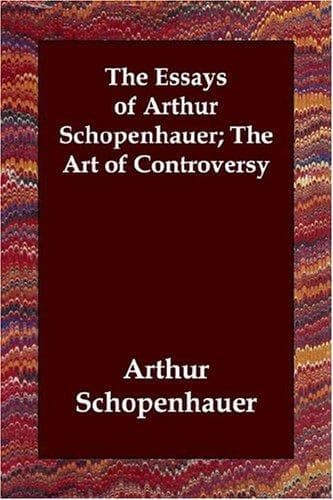
The Essays of Arthur Schopenhauer; the Art of ControversySchopenhauer, Arthur
Philosophy
The Essays of Arthur Schopenhauer; the Art of Controversy
Schopenhauer, Arthur
Debates and debating; Logic
The essence of genius is a measure of intellectual power far beyond
that which is required to serve the individual's will. But it is a
measure of a merely relative character, and it may be reached by
lowering the degree of the will, as well as by raising that of the
intellect. There are men whose intellect predominates over their
will, and are yet not possessed of genius in any proper sense. Their
intellectual powers do, indeed, exceed the ordinary, though not to any
great extent, but their will is weak. They have no violent desires;
and therefore they are more concerned with mere knowledge than with
the satisfaction of any aims. Such men possess talent; they are
intelligent, and at the same time very contented and cheerful.
A clear, cheerful and reasonable mind, such as brings a man happiness,
is dependent on the relation established between his intellect and his
will--a relation in which the intellect is predominant. But genius and
a great mind depend on the relation between a man's intellect and that
of other people--a relation in which his intellect must exceed theirs,
and at the same time his will may also be proportionately stronger.
That is the reason why genius and happiness need not necessarily exist
together.
When the individual is distraught by cares or pleasantry, or tortured
by the violence of his wishes and desires, the genius in him is
enchained and cannot move. It is only when care and desire are silent
that the air is free enough for genius to live in it. It is then that
the bonds of matter are cast aside, and the pure spirit--the pure,
knowing subject--remains. Hence, if a man has any genius, let him
guard himself from pain, keep care at a distance, and limit his
desires; but those of them which he cannot suppress let him satisfy to
the full. This is the only way in which he will make the best use of
his rare existence, to his own pleasure and the world's profit.
To fight with need and care or desires, the satisfaction of which is
refused and forbidden, is good enough work for those who, were
they free of would have to fight with boredom, and so take to bad
practices; but not for the man whose time, if well used, will bear
fruit for centuries to come. As Diderot says, he is not merely a moral
being.
Mechanical laws do not apply in the sphere of chemistry, nor do
chemical laws in the sphere in which organic life is kindled. In the
same way, the rules which avail for ordinary men will not do for the
exceptions, nor will their pleasures either.
Public-domain text, read in full here on John Shaqi.
Reviews
Reviews
No reviews yet
Be the first to share your thoughts on this work.
Elsewhere in the archive
Join the Discussion
Join the discussion
Sign in to leave a comment or review.
Sign InorCreate an account