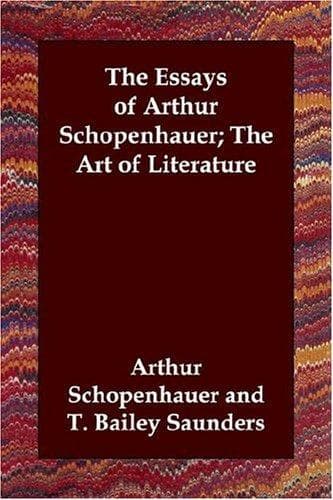
The Essays of Arthur Schopenhauer; The Art of LiteratureSchopenhauer, Arthur
Philosophy
The Essays of Arthur Schopenhauer; The Art of Literature
Schopenhauer, Arthur
Literature -- Philosophy
When an _hypothesis_ has once come to birth in the mind, or gained a
footing there, it leads a life so far comparable with the life of an
organism, as that it assimilates matter from the outer world only when
it is like in kind with it and beneficial; and when, contrarily, such
matter is not like in kind but hurtful, the hypothesis, equally with
the organism, throws it off, or, if forced to take it, gets rid of it
again entire.
To gain _immortality_ an author must possess so many excellences that
while it will not be easy to find anyone to understand and appreciate
them all, there will be men in every age who are able to recognize
and value some of them. In this way the credit of his book will be
maintained throughout the long course of centuries, in spite of the
fact that human interests are always changing.
An author like this, who has a claim to the continuance of his life
even with posterity, can only be a man who, over the wide earth, will
seek his like in vain, and offer a palpable contrast with everyone
else in virtue of his unmistakable distinction. Nay, more: were he,
like the wandering Jew, to live through several generations, he would
still remain in the same superior position. If this were not so, it
would be difficult to see why his thoughts should not perish like
those of other men.
_Metaphors_ and _similes_ are of great value, in so far as they
explain an unknown relation by a known one. Even the more detailed
simile which grows into a parable or an allegory, is nothing more than
the exhibition of some relation in its simplest, most visible and
palpable form. The growth of ideas rests, at bottom, upon similes;
because ideas arise by a process of combining the similarities and
neglecting the differences between things. Further, intelligence, in
the strict sense of the word, ultimately consists in a seizing of
relations; and a clear and pure grasp of relations is all the more
often attained when the comparison is made between cases that lie wide
apart from one another, and between things of quite different nature.
As long as a relation is known to me as existing only in a single
case, I have but an _individual_ idea of it--in other words, only an
intuitive knowledge of it; but as soon as I see the same relation in
two different cases, I have a _general_ idea of its whole nature, and
this is a deeper and more perfect knowledge.
Since, then, similes and metaphors are such a powerful engine of
knowledge, it is a sign of great intelligence in a writer if his
similes are unusual and, at the same time, to the point. Aristotle
also observes that by far the most important thing to a writer is
to have this power of metaphor; for it is a gift which cannot be
acquired, and it is a mark of genius.
Public-domain text, read in full here on John Shaqi.
Reviews
Reviews
No reviews yet
Be the first to share your thoughts on this work.
Join the Discussion
Join the discussion
Sign in to leave a comment or review.
Sign InorCreate an account