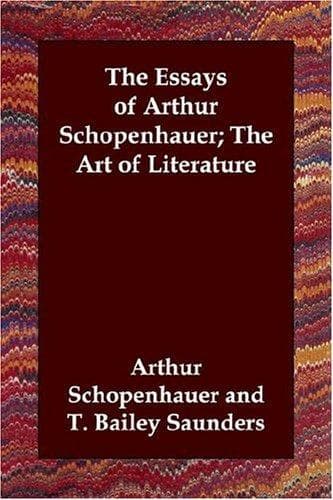
The Essays of Arthur Schopenhauer; The Art of Literature — John Shaqi
The Essays of Arthur Schopenhauer; The Art of LiteratureSchopenhauer, Arthur
Philosophy
The Essays of Arthur Schopenhauer; The Art of Literature
Schopenhauer, Arthur
Literature -- Philosophy
From another point of view, we might look upon history as the sequel
to zoology; for while with all other animals it is enough to observe
the species, with man individuals, and therefore individual events
have to be studied; because every man possesses a character as an
individual. And since individuals and events are without number or
end, an essential imperfection attaches to history. In the study of
it, all that a man learns never contributes to lessen that which he
has still to learn. With any real science, a perfection of knowledge
is, at any rate, conceivable.
When we gain access to the histories of China and of India, the
endlessness of the subject-matter will reveal to us the defects in the
study, and force our historians to see that the object of science is
to recognize the many in the one, to perceive the rules in any given
example, and to apply to the life of nations a knowledge of mankind;
not to go on counting up facts _ad infinitum_.
There are two kinds of history; the history of politics and the
history of literature and art. The one is the history of the will;
the other, that of the intellect. The first is a tale of woe, even of
terror: it is a record of agony, struggle, fraud, and horrible murder
_en masse_. The second is everywhere pleasing and serene, like the
intellect when left to itself, even though its path be one of error.
Its chief branch is the history of philosophy. This is, in fact, its
fundamental bass, and the notes of it are heard even in the other
kind of history. These deep tones guide the formation of opinion, and
opinion rules the world. Hence philosophy, rightly understood, is a
material force of the most powerful kind, though very slow in its
working. The philosophy of a period is thus the fundamental bass of
its history.
The NEWSPAPER, is the second-hand in the clock of history; and it is
not only made of baser metal than those which point to the minute and
the hour, but it seldom goes right.
The so-called leading article is the chorus to the drama of passing
events.
Exaggeration of every kind is as essential to journalism as it is to
the dramatic art; for the object of journalism is to make events go
as far as possible. Thus it is that all journalists are, in the very
nature of their calling, alarmists; and this is their way of giving
interest to what they write. Herein they are like little dogs; if
anything stirs, they immediately set up a shrill bark.
Therefore, let us carefully regulate the attention to be paid to this
trumpet of danger, so that it may not disturb our digestion. Let us
recognize that a newspaper is at best but a magnifying-glass, and very
often merely a shadow on the wall.
The _pen_ is to thought what the stick is to walking; but you walk
most easily when you have no stick, and you think with the greatest
perfection when you have no pen in your hand. It is only when a man
begins to be old that he likes to use a stick and is glad to take up
his pen.
Public-domain text, read in full here on John Shaqi.
Reviews
Reviews
No reviews yet
Be the first to share your thoughts on this work.
Join the Discussion
Join the discussion
Sign in to leave a comment or review.
Sign InorCreate an account